How to Automate the Complete Loan Origination Process
By Roopya
12 Views
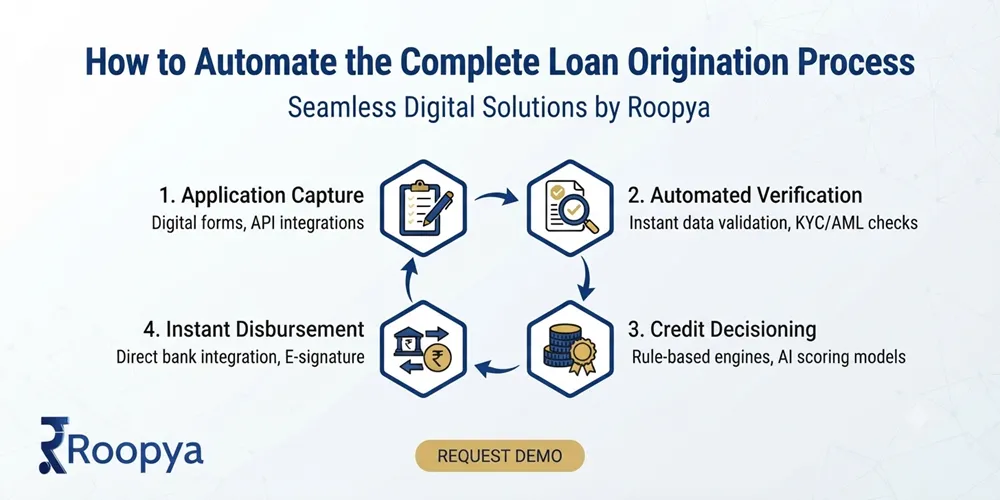
Every lender eventually runs into the same wall: application volumes grow faster than the operations team that processes them. Credit officers re-key the same borrower details from PDFs into spreadsheets. Underwriters wait on a bureau pull that should take seconds. Files sit in someone's inbox for approval while the borrower calls to ask what's happening. None of this is a talent problem — it's a process problem, and it's the reason loan origination automation has moved from a "nice to have" to a competitive necessity for banks, NBFCs and digital lenders alike.
This guide walks through what it actually means to automate the loan origination process end to end — not just digitizing a form, but connecting every stage from application intake to disbursement into a single, rules-driven workflow. You'll find the stages that make up origination, the technology that automates each one, a practical implementation roadmap, the benefits lenders typically see, and the mistakes worth avoiding.
What Is Loan Origination Process Automation?
Loan origination is the journey a loan application takes from the moment a borrower applies to the moment funds are disbursed. In a manual setup, that journey passes through several departments and systems — a sales or relationship team collects documents, an operations team keys them into a core system, a credit team pulls bureau reports and calculates ratios by hand, an underwriter reviews the file, and a disbursement team initiates the payout once approvals are signed off. Each handoff adds delay, and each manual data entry point adds risk of error.
Loan origination automation replaces these manual handoffs with a connected digital workflow. A modern Loan Origination System (LOS) captures the application digitally, pulls KYC and credit data through APIs, applies underwriting rules through a business rule engine (BRE), routes exceptions to the right human reviewer, and triggers disbursement automatically once every condition is met. The goal isn't to remove humans from lending — it's to remove humans from repetitive, rules-based tasks so they can focus on judgment calls that actually need a human.
The Seven Stages of the Loan Origination Process
Before automating anything, it helps to break the process into its component stages. Every lending product — personal loans, business loans, gold loans, home loans or payday advances — moves through some version of the following seven stages.
1. Application Intake and Lead Capture
The process begins when a borrower submits an application, whether through a website form, a mobile app, a partner's platform (in an embedded finance or co-lending setup), or a field agent using a tablet. This stage captures basic borrower details, the loan amount and purpose requested, and consent for data checks.
2. KYC and Identity Verification
Before any credit decision can be made, the lender must confirm the applicant is who they claim to be. This includes Aadhaar or PAN verification, video KYC or biometric checks, and screening against sanctions or negative lists as required under RBI's KYC and AML guidelines.
3. Document Collection and Verification
Income proof, bank statements, address proof and, for business loans, GST returns or financial statements need to be collected and verified for authenticity. This is historically one of the slowest stages, since documents arrive in inconsistent formats and quality.
4. Credit Assessment and Bureau Checks
The lender pulls credit bureau reports (CIBIL, Experian, CRIF, Equifax), evaluates repayment history, existing obligations and exposure, and may layer in alternative data — utility payments, bank transaction patterns, or GST filing consistency — for a fuller risk picture.
5. Underwriting and Decisioning
This is where credit policy is applied: eligibility rules, debt-to-income thresholds, loan-to-value limits, pricing bands and any manual review triggers for borderline cases. The output is an approve, reject, or refer-for-review decision, often along with an approved amount and interest rate that may differ from what was requested.
6. Sanction, Agreement and e-Signing
Once approved, the lender generates a sanction letter and loan agreement, collects the borrower's consent through an e-signature or Aadhaar-based e-sign, and sets up the repayment mandate — typically an e-NACH or UPI Autopay mandate for EMI collection.
7. Disbursement
Funds are transferred to the borrower's verified bank account, and the loan record is handed off to the servicing or Loan Management System for the life of the loan. This is also the point where the lender books the loan on its books and begins regulatory reporting.
Why Manual Origination Breaks Down at Scale
Each of the seven stages above involves data that already exists somewhere — a government database, a credit bureau, a bank's core system — but in a manual process, that data has to be requested, received and re-entered by hand. A few consequences follow predictably:
• Turnaround time stretches from minutes to days, and every extra day increases the chance a borrower abandons the application or accepts a competitor's offer.
• Manual re-keying of bureau numbers, income figures and loan amounts introduces errors that surface later as underwriting or compliance issues.
• Credit policy gets applied inconsistently across branches or credit officers, since interpretation varies person to person.
• Operational costs scale linearly with volume — doubling loan applications means roughly doubling the credit and operations headcount.
• Audit trails are incomplete or scattered across emails, spreadsheets and physical files, which becomes a real problem during an RBI or internal audit.
• Fraud is harder to catch, because a single reviewer working through dozens of files a day is more likely to miss a doctored document or an inconsistency across submissions.
None of these are edge cases — they are the default outcome of scaling a manual process. Automation addresses each one directly by removing the re-keying step and applying policy through software rather than individual judgment.
The Technology Stack Behind an Automated Loan Origination Process
Automating origination end to end depends on a handful of technology building blocks working together. Understanding these makes it much easier to evaluate an LOS vendor or plan an in-house build.
API-Based Data Connections
Every external data source a lender needs — credit bureaus, PAN and Aadhaar verification, bank statement analysis, GST data, fraud databases — is available through APIs today. A modern LOS pre-integrates with these providers so a lender doesn't have to negotiate and build each connection individually. Roopya, for instance, ships with 300+ pre-integrated APIs spanning bureaus, verification services and payment gateways, which is usually the single biggest accelerator to going live quickly.
AI-Powered Document Processing
Optical character recognition (OCR) combined with natural language processing (NLP) can extract data from PAN cards, bank statements, salary slips and GST returns automatically, cross-check the extracted values against what the borrower entered, and flag inconsistencies or signs of tampering. This turns a stage that used to take a document-verification team hours per file into a near-instant automated check.
A No-Code Business Rule Engine (BRE)
The BRE is where credit policy lives in software form: eligibility criteria, income multiples, FOIR (fixed obligation to income ratio) limits, loan-to-value caps, pricing logic and approval hierarchies. A no-code BRE lets credit and risk teams update these rules themselves through a visual interface, rather than filing a change request with engineering every time policy shifts — which matters because credit policy changes far more often than most core banking software gets updated.
eKYC and Digital Identity Verification
Aadhaar-based eKYC, video KYC and liveness detection let a lender verify identity in real time instead of scheduling a branch visit or waiting for physical documents to be couriered and checked.
Credit Scoring and Alternative Data Models
Beyond the traditional bureau score, machine learning models can incorporate bank transaction data, utility payment history and behavioral signals to score thin-file or new-to-credit borrowers who would otherwise be rejected outright by a bureau-only approach.
e-Signature and e-Mandate Infrastructure
Aadhaar e-sign for loan agreements and e-NACH or UPI Autopay for EMI mandates remove the need for physical signatures and post-dated cheques, which used to add days to the sanction-to-disbursement gap.
Workflow and Case Management
Not every application should be fully automated — some need a human underwriter to review a borderline case. A good workflow layer routes exceptions to the right reviewer automatically, tracks SLAs, and keeps a complete, timestamped audit trail of every decision and the data it was based on.
A Practical Roadmap: Automating Each Stage Step by Step
With the stages and technology building blocks in mind, here's how a lender typically moves from a manual process to a fully automated one.
Step 1: Digitize application intake
1. Replace paper or PDF application forms with a dynamic digital form on web and mobile that adapts fields based on the loan product selected.
2. Pre-fill known fields using PAN or mobile number lookups so returning or pre-approved customers spend less time typing.
3. Capture explicit digital consent for KYC, bureau pulls and data sharing at the point of application, satisfying compliance requirements upfront.
Step 2: Automate KYC and identity checks
4. Integrate Aadhaar-based eKYC or video KYC so identity is verified in the same session as the application, not days later.
5. Run PAN validation and sanctions/negative-list screening automatically as soon as the borrower submits their details.
Step 3: Automate document collection and verification
6. Let borrowers upload documents directly, or pull bank statements and GST data digitally through account aggregator or GSTN APIs instead of asking for manual uploads.
7. Apply OCR and AI-based document forensics to extract data and flag tampering, blurred images or mismatched details instantly.
Step 4: Automate credit assessment
8. Trigger bureau pulls automatically once KYC clears, and normalize the data into a standard risk profile.
9. Layer in alternative data sources for thin-file applicants where bureau history alone isn't sufficient.
Step 5: Configure the underwriting rule engine
10. Translate the lender's existing credit policy into rules inside a no-code BRE — eligibility thresholds, FOIR limits, pricing bands and auto-approval versus manual-review triggers.
11. Set clear referral rules so only genuinely borderline applications reach a human underwriter, while clear approvals and clear rejections process automatically.
Step 6: Automate sanction and agreement execution
12. Auto-generate the sanction letter and loan agreement from the approved terms, and route them for Aadhaar e-sign.
13. Set up the EMI repayment mandate (e-NACH or UPI Autopay) as part of the same digital session, rather than a separate follow-up step.
Step 7: Automate disbursement and handoff to servicing
14. Trigger disbursement automatically once the agreement is signed and the mandate is active, using a payment gateway or banking API.
15. Pass the loan record directly into the Loan Management System so repayment schedules, statements and collections start without any manual data re-entry.
What Automation Actually Delivers: Measurable Benefits
Lenders who automate origination end to end typically see improvement across five areas:
• Speed: Document verification that used to take hours can complete in seconds with AI-powered OCR, and full application-to-disbursement cycles that took days can shrink to minutes for straightforward, policy-compliant applications.
• Accuracy: Machine-learning-based credit scoring and automated document checks typically outperform manual review on consistency, since software applies the same criteria to every file without fatigue.
• Cost efficiency: Because API-driven checks and rule-based decisioning replace repetitive manual work, lenders can process significantly higher application volumes without proportionally growing their operations headcount.
• Fraud reduction: AI-based fraud detection modules that check documents, device signals and application patterns catch a meaningfully higher share of fraudulent applications than manual review alone.
• Compliance and auditability: An automated workflow logs every check, decision and data source it relied on, which makes regulatory reporting and internal audits far less painful than reconstructing a paper trail after the fact.
Choosing the Right Loan Origination Automation Platform
Not every LOS platform automates the full process — some only digitize the application form and leave credit assessment, underwriting and disbursement as manual steps bolted on afterward. When evaluating a platform, it's worth checking for a few things specifically:
• Pre-integrated data sources: Does the platform already connect to the bureaus, KYC providers and payment rails you need, or will each integration be a separate project?
• A genuinely no-code business rule engine: Can your credit and risk team update underwriting rules themselves, or does every policy change require a developer ticket?
• Coverage of the full lifecycle: Does the platform handle origination through to servicing and collections, or will you need to stitch together separate systems and manage the data handoff yourself?
• Flexible, usage-based pricing: Can you start small and pay based on actual loan volume, rather than committing to a large upfront license fee before you know the platform fits?
• Built-in compliance: Does the platform stay current with RBI and other regulatory requirements automatically, or is that left to your team to track and implement?
• Speed to go live: Can you actually launch a loan product in days, or does implementation realistically take months?
Roopya's Loan Origination Platform is built specifically around these requirements — a no-code, unified lending infrastructure with 300+ pre-integrated APIs, a self-configurable business rule engine, AI-powered document analysis and fraud detection, and 20+ pre-configured loan products, so lenders can go live in as little as a day rather than months. Because origination and servicing run on the same platform, there's no manual handoff between the Loan Origination System and the Loan Management System once a loan is disbursed.
Common Mistakes to Avoid When Automating Origination
Automating a broken process instead of fixing it first
Automation speeds up whatever process it's applied to — including a badly designed one. It's worth reviewing and simplifying the existing credit policy and workflow before encoding it into a rule engine, rather than automating years of accumulated exceptions and workarounds.
Treating full automation as the only goal
Not every decision should be automated. Genuinely borderline applications, high-value loans, or first-time product launches benefit from human review while the rules are being validated. The right target is usually a high percentage of straightforward cases handled end to end, with clear, well-defined referral paths for the rest.
Skipping the fraud and compliance layer
Speed without adequate fraud checks and audit trails just means bad applications get approved faster. Fraud detection, KYC/AML screening and complete logging need to be built into the workflow from day one, not added later.
Underestimating data quality issues
Automated systems are only as good as the data feeding them. Bureau data can be incomplete, bank statement formats vary widely, and document quality from mobile uploads is inconsistent. A good platform accounts for this with validation and fallback rules rather than assuming clean data.
Choosing a platform that only automates part of the journey
A system that automates document collection but still requires manual bureau pulls, or automates underwriting but leaves disbursement as a manual banking step, only removes some of the friction. The biggest gains come from automating the full chain from application to disbursement, including the handoff into loan servicing.
Getting Started
The lenders who benefit most from origination automation are rarely the ones who wait for a perfect, fully custom-built system. They start with a platform that already covers the common ground — bureau integrations, KYC, a rule engine, e-sign and disbursement — configure it to their specific credit policy and loan products, and refine it as real application data comes in.
If you're evaluating how to automate loan origination for your bank, NBFC or lending business, you can explore Roopya's Loan Origination Platform or book a walkthrough with the team at
roopya.money/contact-us to see the full workflow configured for your product.
Frequently Asked Questions
What does it mean to automate the loan origination process?
Loan origination automation replaces manual, paper-based steps — application intake, KYC, document checks, credit scoring, underwriting, approval and disbursement — with a digital, rules-driven workflow. A Loan Origination System (LOS) like Roopya connects credit bureaus, KYC providers, banking data and payment rails through APIs so that most applications move from submission to disbursement without a human touching a file at every stage.
How long does it take to implement an automated LOS?
Timelines depend on how much customization a lender needs. A no-code, pre-integrated platform can go live in a matter of days for standard loan products, since credit bureau connections, eKYC and payment APIs are already built in. Highly customized workflows with bespoke underwriting logic typically take a few weeks longer for configuration and testing.
Is loan origination automation only for large banks?
No. NBFCs, MFIs, fintech lenders and even small-ticket digital lenders benefit from automation, often more than large banks, because automation lets a lean team process high application volumes without proportionally growing headcount. Usage-based, no-code platforms have made automation accessible to lenders of every size.
Does automating loan origination increase the risk of fraud?
Automation generally reduces fraud risk rather than increasing it, provided the platform includes dedicated fraud checks. AI-based document forensics, biometric and liveness checks, device fingerprinting and bureau cross-verification catch inconsistencies far more consistently than manual review, which is prone to fatigue and human error.
Can an automated loan origination system stay compliant with RBI and other regulations?
Yes, when the platform is built with compliance in mind. Automated systems can enforce KYC and AML checks, maintain complete audit trails, apply fair-lending rules consistently and generate the reports regulators expect, which is often harder to guarantee with manual processes.
What is the difference between a Loan Origination System (LOS) and a Loan Management System (LMS)?
An LOS handles everything from the moment a borrower applies until the loan is disbursed — application capture, KYC, credit checks, underwriting and sanction. An LMS takes over after disbursement, managing repayment schedules, collections, customer servicing and portfolio reporting for the life of the loan. Many lenders use a unified platform that covers both, so data flows between origination and servicing without manual re-entry.
How much does loan origination automation typically cost?
Costs vary by vendor and model. Traditional enterprise LOS deployments often involve licensing fees and lengthy implementation projects, while usage-based or pay-as-you-go platforms let lenders start with minimal upfront investment and pay based on loan volume, which suits NBFCs and newer lenders that want to control costs while scaling.