API-First Loan Management Software for Fintech Companies
By Roopya
5 Views
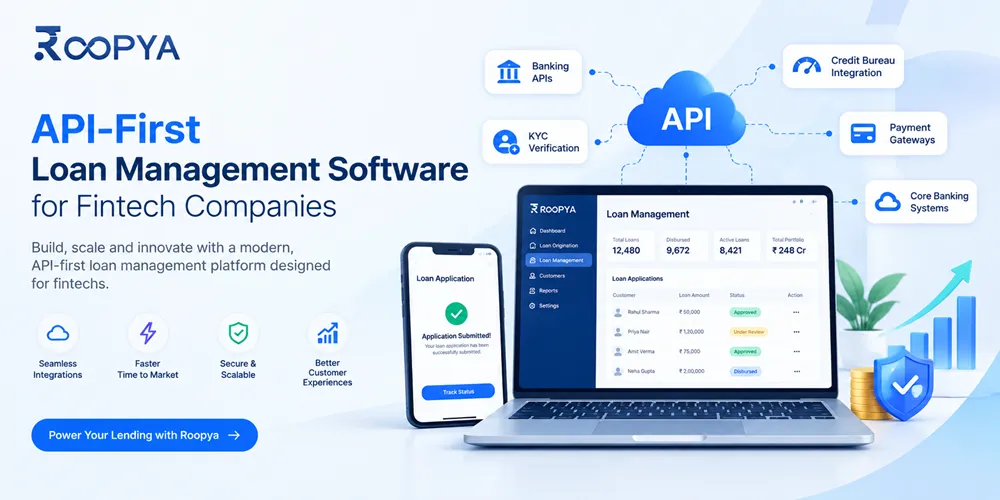
Every fintech company eventually hits the same wall: the lending idea is ready, the credit model works on paper, and the go-to-market plan is solid — but the technology underneath can't keep up. Legacy loan management systems (LMS) are built like sealed boxes. They store your data, run your calculations, and rarely let you touch anything from the outside. For a fintech that needs to connect to five payment gateways, three credit bureaus, a KYC provider, a co-lending bank partner, and its own mobile app — all at once, and all changing every quarter — a sealed box is the wrong foundation.
That is the exact gap API-first loan management software is built to close. Instead of treating integrations as an afterthought, an API-first LMS is designed from day one so that every function — origination, underwriting, disbursal, repayment, collections, and reporting — is exposed as a documented, callable API. This guide explains what API-first loan management software actually means, why fintech companies are standardizing on it, what to look for in a platform, and how Roopya has built its lending infrastructure around this exact principle.
What Is an API-First Loan Management System?
An API-first loan management system is a lending platform where the Application Programming Interface (API) is treated as the primary product, not a secondary feature bolted onto a user interface. In practice, this means every module of the lending lifecycle — customer onboarding, credit scoring, loan disbursal, EMI scheduling, payment collection, and reporting — is built as an independent, well-documented API endpoint before any screen or dashboard is designed around it.
This is fundamentally different from a traditional LMS, where the software is built around a fixed user interface and APIs are added later, often as a limited, rigid layer that exposes only a fraction of what the system can actually do. In a true API-first architecture, your engineering team can build a custom mobile app, embed lending inside an existing product, or connect a completely different front end — and still access 100% of the platform's underlying capability through the API layer.
For fintech companies, this distinction is not academic. It determines how fast you can launch a new loan product, how easily you can plug in a new partner bank or NBFC, and how much engineering time gets spent on integration work versus building your actual product.
Why Fintech Companies Are Moving Toward API-First Lending Infrastructure
A handful of structural shifts in Indian and global fintech are pushing lending infrastructure toward API-first design.
1. Embedded finance has made lending a feature, not a product
E-commerce platforms, HR-tech apps, B2B marketplaces, and vertical SaaS companies increasingly want to offer lending inside their existing product — a 'Buy Now, Pay Later' option at checkout, a payroll advance inside an HR app, or working capital inside a supplier portal. This only works if the lending engine can be called programmatically from another application's codebase, which is only possible with an API-first LMS.
2. Fintechs work with multiple partners simultaneously
A typical digital lender integrates with two or three credit bureaus, several KYC and e-sign providers, multiple payment gateways and banking rails, one or more co-lending or balance-sheet partners, and communication providers for SMS, WhatsApp, and email. Each of these needs to talk to the LMS. An API-first system pre-integrates the common ones and exposes a standard interface for the rest, instead of requiring a custom integration project for every partner.
3. Speed to market is a competitive necessity
In a crowded lending market, the fintech that launches a new loan product in weeks rather than months captures the opportunity first. API-first platforms let product and engineering teams configure new loan products, credit rules, and journeys through APIs and no-code tools rather than waiting on a vendor's development queue.
4. Composability protects against vendor lock-in
When every function of the LMS is available as an API, a fintech can swap out a single component — say, replace one payment gateway with another, or add a second credit bureau — without re-architecting the entire stack. This modularity is difficult or impossible with a monolithic legacy system.
5. Regulatory and audit requirements demand traceability
RBI's Digital Lending Guidelines and co-lending frameworks require clear audit trails, structured data exchange between lenders and Loan Service Providers (LSPs), and transparent disclosure to borrowers. API-first systems naturally produce structured, timestamped, machine-readable records of every event in the loan lifecycle, which makes compliance reporting significantly easier.
Core Features of a True API-First Loan Management Platform
Not every platform that markets itself as 'API-enabled' is genuinely API-first. Here are the features that separate a real API-first LMS from a legacy system with a thin API layer on top.
Open, Documented REST APIs for Every Module
Origination, underwriting, disbursal, repayment, foreclosure, collections, and reporting should each have their own well-documented REST endpoints, with request/response examples, authentication details, and versioning — not just a handful of APIs for the most common actions.
Pre-Integrated Ecosystem
A mature API-first LMS ships with ready connections to credit bureaus (CIBIL, Experian, Equifax, CRIF), KYC and e-KYC providers (DigiLocker, UIDAI), payment gateways and banking rails, NACH/eNACH mandate systems, and communication channels (SMS, email, WhatsApp). This removes months of integration work that would otherwise sit on the fintech's own engineering roadmap.
No-Code Configuration Layered on Top of APIs
The best platforms combine API access for developers with no-code tools for business teams — so credit policies, approval workflows, interest structures, and fee rules can be changed by a risk or product manager without writing code or filing a change request with engineering.
Modular, Microservices-Based Architecture
Each function of the platform runs as an independent service. This means a spike in disbursal volume doesn't slow down collections, and a new module can be added without redeploying the entire system.
Real-Time Webhooks and Event Streaming
Beyond request-response APIs, an API-first LMS should push real-time events — loan approved, EMI collected, payment failed, account gone delinquent — to your systems via webhooks, so your app, CRM, or data warehouse stays in sync without constant polling.
Cloud-Native, Elastic Scalability
Since API calls can spike unpredictably (a marketing campaign, a festive-season BNPL surge, a new partner going live), the underlying infrastructure needs to scale automatically rather than requiring manual capacity planning.
Security and Compliance Built Into the API Layer
API keys, OAuth-based authentication, role-based access control, IP whitelisting, rate limiting, and encryption in transit and at rest should be native to the platform — not something the fintech has to build separately around it.
Key Benefits of API-First Loan Management Software for Fintechs
● Faster go-to-market: Launch new loan products and journeys in days or weeks instead of months, since integrations and configuration happen through APIs and no-code tools rather than custom development.
● Lower engineering overhead: Pre-built connectors to bureaus, KYC, payments, and banking rails mean your engineering team focuses on your product experience, not repetitive integration plumbing.
● True embedded finance capability: Lending can be embedded directly inside your app, checkout flow, or partner's platform, since every function is callable from outside the LMS.
● Consistent, controllable borrower experience: You control the entire front-end experience while the LMS handles credit logic, servicing, and compliance in the background.
● Real-time visibility: Webhooks and event streams give your risk, ops, and finance teams live data instead of waiting for batch reports.
● Future-proof, composable stack: You can add a new bureau, switch a payment gateway, or plug in a new co-lending partner without re-platforming.
● Multi-product, multi-partner scale: The same API-first core can power personal loans, BNPL, gold loans, and SME loans, and support multiple lending partners, without duplicating infrastructure.
API-First vs Traditional Loan Management Systems
The table below summarizes the practical differences fintech teams experience when comparing an API-first LMS to a conventional, UI-first system.
Dimension
API-First LMS
Integration approach
APIs available for every module from day one
Limited APIs bolted onto a fixed UI, often incomplete
New loan product launch
Days to weeks via API and no-code configuration
Months, often requiring vendor development cycles
Embedding into other apps
Native — lending can run inside any front end
Difficult or impossible without heavy custom work
Partner ecosystem
Pre-integrated bureaus, KYC, payments, banking rails
Each integration built and maintained separately
Scalability
Cloud-native, elastic, module-by-module scaling
Often monolithic; scaling means scaling everything
Vendor lock-in risk
Low — components can be swapped independently
High — replacing one function can mean re-platforming
Compliance & audit trail
Structured, timestamped, machine-readable by design
Often reconstructed manually from logs and reports
Use Cases: How Fintechs Use API-First LMS Across Lending Models
Digital Personal Loans
Fintechs offering instant personal loans use API-first LMS platforms to call credit bureau APIs, run automated eligibility and scoring, and disburse funds — all within a single app session, with no manual handoffs.
BNPL and Checkout Lending
Buy Now, Pay Later requires a lending decision to happen inside someone else's checkout flow in milliseconds. This is only achievable when the LMS's underwriting and disbursal functions are exposed as fast, reliable APIs that the merchant's checkout can call directly.
Embedded Lending in Marketplaces and Vertical Apps
HR platforms offering salary advances, B2B marketplaces offering supplier financing, and vertical SaaS products offering working capital all embed lending using API-first infrastructure, so borrowers never have to leave the host application.
Co-Lending and Loan Service Provider (LSP) Models
Under RBI's co-lending framework, an LSP and a regulated lender (bank or NBFC) must exchange loan-level data continuously and transparently. API-first systems make this data exchange structured and automatic rather than a manual reconciliation exercise.
SME and Business Loans
SME lending often requires pulling GST returns, bank statement data, and alternative data sources — each via its own API — and feeding them into a custom scorecard. An open API architecture lets fintechs assemble this pipeline without waiting on the LMS vendor.
Secured Lending: Gold Loans and Asset-Backed Products
Even asset-backed products benefit from API-first infrastructure: valuation, appraisal, and collateral management modules need to sync with field agents, branch systems, and mobile apps in real time.
How Roopya Delivers API-First Loan Management for Fintech Companies
Roopya (roopya.money) is built as a no-code, AI-first, cloud-native lending infrastructure that treats APIs as the foundation of the platform, not an add-on. This is reflected across the entire lending lifecycle Roopya covers — origination, servicing, collections, early warning, and analytics.
● 300+ pre-integrated APIs covering credit bureaus, verification services, payment gateways, banking rails, and communication channels — so fintechs don't have to build and maintain these connections themselves.
● Open API architecture across the full stack, allowing fintechs to connect their own front end, CRM, ERP, or partner systems to Roopya's Loan Origination System (LOS), Loan Management System (LMS), and Collections engine.
● A no-code Business Rule Engine (BRE) that sits alongside the API layer, so credit policies and approval workflows can be configured visually while still being fully callable via API.
● AI-powered document analysis, fraud detection, and credit decisioning that fintechs can invoke through the same API layer used for core loan processing.
● 20+ pre-configured loan products spanning personal, business, gold, home, and vehicle loans, each accessible and configurable through APIs.
● A developer sandbox environment with full API documentation, so engineering teams can build and test integrations before going live.
● A 1-day go-live path for standard configurations, with a structured 5–7 day implementation roadmap for full production rollouts including integrations, training, and UAT.
Because Roopya's pricing is usage-based with zero upfront cost, fintechs can start integrating and testing on the API layer before committing to large infrastructure spend — a model that fits how early- and growth-stage fintech companies actually operate.
What Integrating With an API-First LMS Looks Like
For engineering teams evaluating an API-first LMS, the integration path typically follows a predictable pattern:
● Sandbox access and API key generation, so your team can start making test calls immediately.
● Reviewing API documentation for the modules you need first — usually origination and underwriting, followed by servicing and collections.
● Configuring webhooks for the events your systems need to react to in real time, such as approval, disbursal, and payment status changes.
● Running end-to-end test loans through the sandbox to validate the full journey before go-live.
● Moving to production with monitored rollout, rate-limit configuration, and a support channel for the first weeks of live traffic.
Because the APIs are documented and stable from day one, this process typically takes days for a focused integration rather than the multi-month timelines associated with legacy LMS integrations.
Checklist: How to Choose the Right API-First LMS Partner
Before selecting an API-first loan management platform, fintech teams should evaluate:
● API coverage — does every module (origination, servicing, collections, reporting) have a documented API, or only a subset?
● Pre-built integrations — how many credit bureaus, KYC providers, payment gateways, and banking rails are already connected?
● Developer experience — is there a sandbox, clear documentation, versioning, and support for testing before go-live?
● No-code layer — can business teams change credit rules and workflows without filing engineering tickets?
● Scalability — is the platform cloud-native and able to handle volume spikes without manual intervention?
● Compliance readiness — does the platform support RBI digital lending guidelines, co-lending data exchange, and audit trail requirements out of the box?
● Pricing model — is pricing usage-based, or does it require large upfront licensing commitments?
● Implementation timeline — what is the realistic time from sign-up to a production-ready integration?
For fintech companies, the choice of loan management infrastructure is no longer just a back-office decision — it directly determines how fast you can launch products, how many partners you can plug in, and how well you can compete on borrower experience. An API-first loan management system turns every part of the lending lifecycle into a building block your team can assemble, extend, and embed, rather than a fixed interface you have to work around.
Roopya was built on exactly this principle — 300+ pre-integrated APIs, a no-code business rule engine, AI-powered decisioning, and a full origination-to-collections stack, all accessible through open REST APIs, with a go-live path measured in days, not months.
Ready to see it in action? Visit roopya.money to request a demo and explore the API documentation for Roopya's loan origination, loan management, and collections platform.
Frequently Asked Questions (FAQ)
What does "API-first" mean in loan management software?
API-first means the platform is designed so that every function of the loan lifecycle — onboarding, underwriting, disbursal, servicing, and collections — is available as a documented API before any user interface is built around it. This lets fintech teams build their own front end or embed lending into another application while still using the full capability of the platform.
How is an API-first LMS different from a traditional LMS?
A traditional LMS is built around a fixed screen-based interface, with APIs added afterward and often limited to a few common actions. An API-first LMS exposes the entire platform — every module and workflow — through open, well-documented REST APIs from the start, making integration, customization, and embedding significantly faster.
Can fintech companies without a banking or NBFC license use an API-first LMS?
Yes. Many fintech companies operate as Loan Service Providers (LSPs) that originate and service loans on behalf of a partner bank or NBFC. An API-first LMS supports this model by structuring data exchange between the LSP and the regulated lender, in line with RBI's co-lending and digital lending guidelines.
How long does it take to integrate with Roopya's API-first LMS?
Basic sandbox access and initial API testing can begin within hours of sign-up. A full production integration — including payment gateway, credit bureau, and KYC connections, configuration, and testing — typically follows a 5–7 day implementation roadmap, with standard configurations able to go live in as little as one day.
What integrations come pre-built with Roopya's platform?
Roopya ships with 300+ pre-integrated APIs, including credit bureaus (CIBIL, Experian, Equifax, CRIF), KYC providers (DigiLocker, UIDAI), payment gateways (Razorpay, PayU, CCAvenue), banking APIs, and communication channels for SMS, email, and WhatsApp.
Is API-first loan management software secure and compliant with RBI regulations?
A well-built API-first LMS includes encryption in transit and at rest, role-based access control, IP whitelisting, and rate limiting at the API layer, along with structured reporting designed to support RBI digital lending guidelines, NPA and ALM reporting, and audit trail requirements.
Can I use only specific APIs instead of adopting the full platform?
Yes. Because an API-first LMS is modular, fintechs can integrate with individual modules — for example, only the underwriting and disbursal APIs — and add servicing, collections, or analytics modules later as their needs grow, without re-platforming.
What does an API-first loan management system cost?
Pricing varies by platform, but many API-first providers, including Roopya, use a pay-as-you-use model with zero upfront licensing cost, so fintechs pay based on actual loan volume and API usage rather than a large fixed fee.