AI-Powered Loan Management Software: The Future of Digital Lending
By Roopya
49 Views
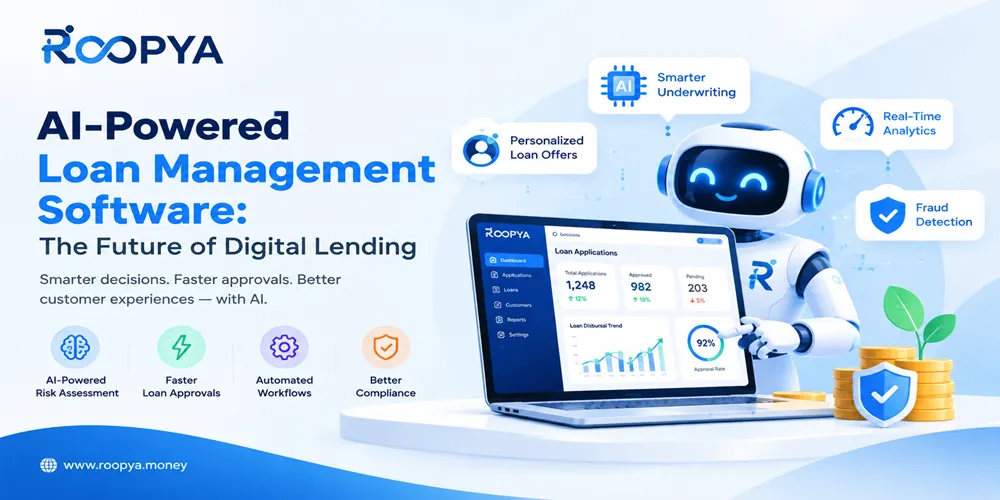
Lending has always been a business of trust, risk, and speed. For decades, banks and non-banking financial companies (NBFCs) relied on manual underwriting, paper-heavy documentation, and rigid legacy systems to originate and manage loans. That world is disappearing fast. Borrowers today expect a loan decision in minutes, not weeks, and regulators expect airtight compliance, accurate reporting, and fraud-free onboarding at the same time. Meeting both expectations with spreadsheets and manual workflows is no longer realistic.
This is where artificial intelligence (AI) enters the picture. AI-powered loan management software is transforming how banks, NBFCs, fintechs, and microfinance institutions originate, service, and collect loans. Instead of treating AI as a bolt-on feature, modern lending platforms are being built with intelligence woven into every stage of the loan lifecycle — from the first click on an application form to the final EMI collected.
In this guide, we will explore what AI-powered loan management software actually means, how it differs from traditional systems, the core features that define a modern platform, the tangible benefits it delivers, the challenges lenders should plan for, and where the industry is headed next. Whether you are a lending business evaluating new technology or simply curious about how digital lending is evolving, this article will give you a complete, practical picture.
What Is AI-Powered Loan Management Software?
Loan Management Software (LMS) is the system of record that governs a loan after it has been disbursed — tracking repayment schedules, interest accrual, penalties, customer communication, and portfolio-level reporting. When paired with a Loan Origination System (LOS), it forms the backbone of a lender’s entire operation, from application intake to loan closure.
AI-powered loan management software takes this foundation and layers machine learning, natural language processing (NLP), and predictive analytics on top of it. Rather than simply recording transactions, the system starts to reason about them: it flags which borrowers are likely to default before they miss a payment, it reads and verifies documents without a human review, and it recommends the next best action for a collections agent based on a borrower’s historical behavior.
In short, a traditional LMS tells you what happened. An AI-powered LMS tells you what is likely to happen next — and often takes action automatically.
From Ledgers to Algorithms: The Evolution of Lending Technology
To appreciate where AI-powered lending software is headed, it helps to understand where it came from.
The paper era. Loan files were physical folders. Credit decisions depended almost entirely on a loan officer’s judgment and a handful of manually verified documents. Turnaround times were measured in weeks.
The digitization era. Banks and NBFCs moved records onto core banking systems and early-generation LMS platforms. Processes became faster, but they were still largely rule-based — a fixed set of if-this-then-that conditions coded by IT teams, with little ability to adapt to new data patterns.
The API and cloud era. Cloud-hosted, API-first platforms allowed lenders to connect to credit bureaus, KYC providers, payment gateways, and e-signature tools. This reduced integration time from months to days and made loan origination journeys largely digital, even if underwriting logic remained static.
The AI-native era. This is where the industry stands today. Modern platforms are architected around continuously learning models rather than fixed rules. Credit scoring, fraud detection, collections prioritization, and even customer support now run on algorithms that improve as more data flows through the system. Business users can configure and retrain rules through no-code interfaces instead of waiting on developer cycles.
This evolution matters because each stage removed friction from a different part of the lending value chain — paper gave way to digital records, digital records gave way to connected systems, and connected systems are now giving way to intelligent, self-optimizing systems.
Core Features of AI-Powered Loan Management Software
Not every platform that claims “AI-powered” status delivers the same depth of intelligence. Here are the features that genuinely define a modern, AI-driven lending stack.
1. AI-Powered Document Analysis
Instead of a human manually checking a PAN card, salary slip, or bank statement, intelligent OCR and NLP engines extract, verify, and cross-check data automatically. High-accuracy document analysis can process identity proofs, income documents, and bank statements in seconds while simultaneously scanning for tampering, mismatched details, or inconsistencies that indicate fraud.
2. Intelligent Credit Decisioning
Traditional credit scoring relies heavily on bureau data — credit history, existing loans, repayment track record. AI-driven credit decisioning goes further, incorporating alternative data such as utility payments, transaction patterns, digital footprint, and behavioral signals. This is especially valuable for “thin file” or new-to-credit borrowers who don’t have an extensive credit history but are otherwise creditworthy. Machine learning models can evaluate thousands of variables simultaneously and return a risk assessment in milliseconds.
3. AI-Enhanced Business Rule Engines (BRE)
A no-code business rule engine lets credit and risk teams configure approval logic, eligibility criteria, and pricing rules without writing code. When enhanced with AI, the BRE goes further: it studies historical approvals and rejections, identifies which rules are actually predictive of default versus which are simply legacy assumptions, and suggests optimizations — all while keeping a human in the loop for final sign-off.
4. Fraud Detection and Risk Monitoring
Fraud in lending has become more sophisticated, ranging from synthetic identities to income document forgery to collusive fraud rings. AI-based fraud modules analyze patterns across thousands of applications simultaneously, catching anomalies a human reviewer would likely miss — duplicate device fingerprints, inconsistent geolocation data, or statistically unusual application clusters.
5. Predictive Early Warning Systems
Rather than waiting for a borrower to miss a payment, predictive models continuously score active loans for early signs of stress — changes in repayment patterns, spending behavior, or external economic indicators. This allows lenders to intervene proactively, offering restructuring or reminders before an account slips into delinquency.
6. Automated, Behavior-Driven Collections
AI-driven collection engines segment borrowers by risk profile and predicted response behavior, then tailor the communication channel, tone, and timing accordingly. Some borrowers respond best to a gentle SMS reminder; others need a phone call. Automating this segmentation measurably improves recovery rates while reducing the operational burden on collections teams.
7. Natural-Language Analytics and Reporting
Modern platforms increasingly let business users simply ask a question in plain English — “What was our default rate for personal loans disbursed in Q2?” — and receive an instant, accurate answer, along with visualizations. This removes the dependency on data analysts for routine reporting and dramatically speeds up decision-making.
8. Portfolio and Amortization Management
At its core, an LMS still needs to do the fundamentals well: accurate amortization schedules, interest accrual, prepayment and foreclosure handling, penalty computation, and a real-time customer portal. AI augments these functions but doesn’t replace the need for rock-solid transaction accuracy.
Why Banks and NBFCs Are Moving to AI-Powered Lending Platforms
The business case for AI-powered loan management software rests on a few clear pillars.
Speed to decision. What used to take a credit officer hours of manual review can now happen in seconds. Faster decisions mean higher conversion rates, because borrowers increasingly abandon applications that take too long.
Lower cost per loan. Automating document verification, credit assessment, and routine collections communication reduces the manpower needed per loan file, which is especially significant for lenders focused on small-ticket, high-volume products where manual processing costs can exceed the interest earned.
Better risk-adjusted returns. More accurate credit decisioning — powered by richer data and continuously learning models — means fewer bad loans get approved and fewer good borrowers get rejected. Over a large portfolio, even a small improvement in accuracy translates into a meaningful reduction in credit losses.
Improved compliance and auditability. AI-powered platforms typically log every decision, every rule that fired, and every override, creating a defensible audit trail for regulators. This is increasingly important as regulatory bodies scrutinize algorithmic lending decisions for fairness and explainability.
Scalability without proportional headcount growth. A lender using an AI-native platform can often grow loan volumes several times over without a proportional increase in operations staff, because the system absorbs the routine, repetitive work.
Better customer experience. From instant eligibility checks to self-service loan tracking to proactive communication, AI-powered systems make the borrower’s experience smoother — which directly affects repeat business and referrals in a competitive lending market.
Traditional LMS vs. AI-Powered LMS: A Side-by-Side View
It’s easiest to see the shift by comparing how the two approaches handle the same tasks.
Capability
Traditional LMS
AI-Powered LMS
Credit decisioning
Fixed rules on bureau data only
Machine learning models using bureau + alternative data
Document verification
Manual review by staff
Automated OCR/NLP verification in seconds
Fraud detection
Reactive, flagged after the fact
Proactive, real-time pattern detection
Collections
Fixed reminder schedule for all borrowers
Behavior-based, personalized outreach
Risk monitoring
Periodic, batch-based reviews
Continuous, real-time scoring
Rule updates
Requires IT/developer involvement
No-code configuration by business teams
Reporting
Static, pre-built reports
Natural-language, ad-hoc analytics
Onboarding new loan products
Weeks to months
Days, using pre-configured templates
This comparison illustrates why so many lenders describe the shift to AI-powered platforms not as an incremental upgrade, but as a fundamentally different operating model for the lending business.
AI Lending Metrics Worth Tracking
Once an AI-powered platform is live, lenders should track a specific set of metrics to confirm the technology is delivering real value, rather than assuming intelligence automatically translates into better outcomes.
Turnaround time (TAT). The time from application submission to final credit decision is one of the clearest indicators of AI impact. A drop from hours or days to minutes is typically the first visible win.
Approval rate versus default rate. It’s not enough to approve more loans faster — the real test is whether approval rates can rise (or stay flat) while default rates fall, indicating the credit model is more accurate, not just more permissive.
Straight-through processing (STP) rate. This measures the percentage of applications that move from submission to disbursal without any manual intervention. A rising STP rate signals that AI-driven document analysis and decisioning are functioning as intended.
Fraud catch rate. Track how many fraudulent applications are identified before disbursal versus after, and compare this against pre-AI baselines to quantify the fraud module’s impact.
Collections recovery rate and cost-to-collect. AI-driven collections should show improvement in both recovery percentage and the operational cost required to achieve it, since these often move in opposite directions with traditional collections approaches.
Model drift and stability. Because AI models are trained on historical data, their accuracy can degrade as market conditions change. Regularly monitoring for model drift — and having a retraining process in place — is essential to keep decisioning accurate over time.
Building Trust: Governance, Human Oversight, and Responsible AI
Because lending directly affects people’s access to credit and financial wellbeing, deploying AI in this space carries a responsibility that goes beyond operational efficiency.
Human-in-the-loop design. The most reliable implementations keep a human reviewer in the loop for edge cases, high-value loans, or any decision the model flags with low confidence, rather than allowing full automation across every scenario without exception handling.
Regular fairness audits. Running periodic audits to check whether approval rates or pricing differ across demographic groups in ways that aren’t justified by legitimate risk factors helps catch unintended bias before it becomes a regulatory or reputational issue.
Clear escalation paths. Borrowers should have a straightforward way to question or appeal an automated decision, with a human able to review the specific factors that drove that outcome.
Documented model versioning. Every time a credit or fraud model is retrained or updated, the change should be logged, tested, and version-controlled, so that any decision can be traced back to the exact model version that produced it — a requirement increasingly expected by regulators and auditors alike.
Lenders that build these governance practices into their AI-powered lending operations from day one tend to scale with far fewer compliance surprises down the road than those who treat governance as an afterthought.
Real-World Applications Across Loan Products
AI-powered loan management software is not a one-size-fits-all tool; its value shows up differently depending on the loan product.
Personal loans and payday/salary-advance loans. These products depend heavily on speed and volume. AI-driven decisioning and document analysis let lenders approve and disburse loans within minutes, which is often the deciding factor for a borrower choosing between competing apps.
Gold loans. While the collateral valuation still requires physical appraisal, everything around it — KYC, documentation, repayment tracking, and renewal reminders — benefits enormously from automation, letting branches process a higher volume of gold loans without adding staff.
Business and SME loans. SME lending is data-intensive — GST filings, bank statements, invoices, and financial ratios all need to be analyzed. AI-based document analysis and alternative credit scoring can dramatically cut the time needed to underwrite a business loan, which historically has been one of the slowest lending categories.
Home and auto loans. These are longer-tenure, higher-ticket loans where fraud detection and early warning systems have an outsized impact, since a single bad loan can carry years of risk exposure. AI helps identify red flags early, both at origination and throughout the loan’s life.
Microfinance and embedded finance. For loan service providers and platforms embedding credit into their own customer journeys (retail, e-commerce, agri-tech, and so on), AI-powered infrastructure allows lending to be offered as a seamless feature rather than a separate, friction-heavy process.
Challenges to Plan For
AI-powered lending software delivers real advantages, but it is not a plug-and-play miracle. Lenders evaluating or implementing these systems should plan for a few recurring challenges.
Data quality and availability. AI models are only as good as the data feeding them. Lenders with limited historical data, especially newer NBFCs, may need time — or a partner platform with pre-trained models — before their AI-driven decisioning reaches full accuracy.
Model explainability. Regulators and internal risk committees increasingly expect lenders to explain why an algorithm approved or rejected a specific application. Black-box models that cannot produce a clear rationale create both regulatory and reputational risk, so explainability should be a non-negotiable requirement when selecting a platform.
Bias and fairness. Machine learning models can inadvertently learn and reinforce historical biases present in training data. Ongoing model monitoring, fairness testing, and human oversight are essential safeguards, not optional extras.
Integration complexity. Lenders rarely operate in a vacuum — core banking systems, credit bureaus, payment gateways, and third-party verification services all need to connect smoothly. Platforms with a large library of pre-built integrations meaningfully reduce this burden compared to those requiring custom development for every connection.
Change management. Credit and collections teams accustomed to manual judgment calls need training and, often, a mindset shift to trust and effectively supervise AI-assisted decisions rather than treating the system as a black box to be second-guessed or blindly followed.
Regulatory alignment. Lending regulations evolve, and vary by jurisdiction and loan product. A platform needs to be built for continuous compliance updates rather than static, one-time certification.
How to Choose the Right AI-Powered Loan Management Platform
For banks, NBFCs, and loan service providers evaluating vendors, a structured checklist helps cut through marketing claims.
• Breadth of the lending lifecycle covered — does the platform handle origination, servicing, collections, and early warning as a unified system, or will you need to stitch together multiple point solutions?
• No-code configurability — can business teams adjust rules, workflows, and loan products themselves, or does every change require a developer ticket?
• Depth of pre-built integrations — how many credit bureaus, KYC providers, payment gateways, and verification APIs are already connected out of the box?
• Explainability of AI models — can the platform show why a specific decision was made, in terms a risk officer or auditor can understand?
• Speed of deployment — how long does it realistically take to go from contract signature to a live, processing loan product?
• Pricing model — does the platform charge large upfront license fees, or does it offer a usage-based model that scales with your loan volumes?
• Compliance track record — is the vendor actively maintaining the platform against evolving regulatory requirements in your market?
• Support for multiple loan products — can the same platform support personal loans, SME loans, gold loans, and other products without a complete re-implementation?
The Future of AI in Digital Lending
Several trends are likely to shape the next phase of AI-powered lending software.
Generative AI for customer interaction. Conversational AI is moving beyond simple chatbots toward handling nuanced borrower queries, negotiating repayment plans, and guiding applicants through complex documentation — all in natural language and, increasingly, in regional languages.
Real-time, continuous underwriting. Instead of a single credit decision at origination, platforms are moving toward continuously updated risk scores throughout the loan’s life, informed by real-time transaction and behavioral data.
Deeper embedded finance integration. As more non-financial platforms — e-commerce, logistics, agri-tech, healthcare — embed lending into their core offering, AI-powered infrastructure will increasingly operate invisibly behind another company’s brand, disbursing credit at the exact moment a customer needs it.
Federated and privacy-preserving learning. As data privacy regulations tighten, expect more lending platforms to adopt techniques that let models learn from distributed data sources without centralizing sensitive customer information.
Explainable AI as a standard, not a differentiator. As regulatory scrutiny of algorithmic decisions increases globally, explainability will shift from being a competitive advantage to a baseline requirement for any lending platform.
Hyper-personalized loan products. Rather than offering a fixed catalog of loan products, AI will increasingly allow lenders to dynamically tailor loan amount, tenure, and pricing to each borrower’s specific risk profile and needs in real time.
The Roopya Advantage: AI-Powered Lending Infrastructure in Practice
Roopya is a no-code, unified lending infrastructure built for banks, NBFCs, and loan service providers that want to launch and scale AI-powered lending operations without months of custom development. Rather than stitching together separate origination, servicing, and collections tools, Roopya brings the entire loan lifecycle onto a single platform, with AI embedded at each stage.
On the origination side, Roopya’s AI-powered document analysis extracts and verifies identity documents, income proofs, and bank statements automatically, aiming for over 99% accuracy while simultaneously screening for fraud indicators. Its intelligent credit decisioning engine evaluates both traditional bureau data and alternative signals to return a risk assessment in milliseconds, rather than hours.
Once a loan is live, Roopya’s loan management system handles portfolio tracking, payment processing, and amortization schedules, while its early warning system continuously scores active accounts for signs of repayment stress — allowing lenders to intervene before an account becomes delinquent rather than reacting after the fact. On the recovery side, its AI-driven collections engine adapts communication strategy to each borrower’s predicted response pattern, a design choice aimed at improving recovery rates while reducing the manual workload on collections teams.
Because the platform is genuinely no-code, credit and operations teams can configure loan products, eligibility rules, and workflows themselves through a visual business rule engine, without waiting on a developer backlog. Combined with a library of 300+ pre-integrated APIs spanning credit bureaus, verification services, and payment gateways, this is designed to let lenders go from signed contract to a live, disbursing loan product in as little as a day, on a pay-as-you-use pricing model rather than a large upfront license fee.
For lenders evaluating whether to build AI capability in-house or adopt a purpose-built platform, this kind of pre-integrated, continuously updated infrastructure is often the faster and lower-risk path to putting AI-powered lending into production.
AI-powered loan management software is no longer an experimental add-on for large banks with deep technology budgets — it has become a practical necessity for any lender that wants to compete on speed, accuracy, and cost efficiency. From document analysis and credit decisioning to fraud detection and collections, artificial intelligence is reshaping every stage of the loan lifecycle, turning what used to be slow, manual, judgment-heavy processes into fast, data-driven, continuously improving systems.
That said, technology alone isn’t the whole answer. The lenders that get the most value from AI-powered platforms are the ones that pair strong technology with clean data practices, model governance, and thoughtful change management — treating AI as a powerful decision-support tool rather than a replacement for sound lending judgment.
Platforms like Roopya are built specifically around this idea — a no-code, unified lending infrastructure that brings AI-powered document analysis, intelligent credit decisioning, a self-learning business rule engine, and automated collections together in a single system, so banks, NBFCs, and loan service providers can go live in days rather than months and scale their lending operations without a proportional increase in cost or risk.
Frequently Asked Questions (FAQ)
1. What is AI-powered loan management software? AI-powered loan management software uses machine learning, natural language processing, and predictive analytics to automate and improve loan servicing tasks such as credit decisioning, document verification, fraud detection, and collections — going beyond a traditional LMS that only tracks repayment records.
2. How is AI-powered LMS different from a traditional loan management system? A traditional LMS records and tracks loan transactions based on fixed rules. An AI-powered LMS analyzes patterns in that data to predict outcomes — such as default risk or ideal collections timing — and can automatically recommend or trigger the next best action.
3. Is AI-powered lending software suitable for small NBFCs and loan service providers, not just large banks? Yes. Cloud-based, usage-priced platforms have made AI-powered lending infrastructure accessible to smaller NBFCs, MFIs, and loan service providers, allowing them to compete with larger institutions without large upfront technology investments.
4. Can AI-powered loan management software help with fraud detection? Yes. AI-based fraud modules can analyze document authenticity, device and location data, and behavioral patterns across large volumes of applications to flag suspicious activity that would be difficult for a human reviewer to catch manually.
5. Does using AI in lending decisions create compliance risk? It can, if the models are not explainable or properly monitored. Choosing a platform that provides clear reasoning for every decision, maintains detailed audit logs, and is actively updated for regulatory changes significantly reduces this risk.
6. How long does it take to implement an AI-powered loan management platform? This varies by vendor, but modern no-code, API-first platforms with pre-built integrations can often go live in days, compared to the months typically required for legacy, custom-built systems.
7. What loan products can AI-powered loan management software support? A well-built platform can support a wide range of products, including personal loans, payday/salary-advance loans, gold loans, business and SME loans, home loans, and auto loans, often from a single configurable system.
8. Does AI replace human underwriters and collections agents? No. AI is best used as a decision-support tool that handles routine, repetitive analysis at scale, while human teams focus on judgment calls, exceptions, and relationship-driven interactions — with humans retaining oversight of the system’s decisions.