5 Costly AI Development Failures And What Every Business Should Learn From Them
By Oliver Owens
35 Views
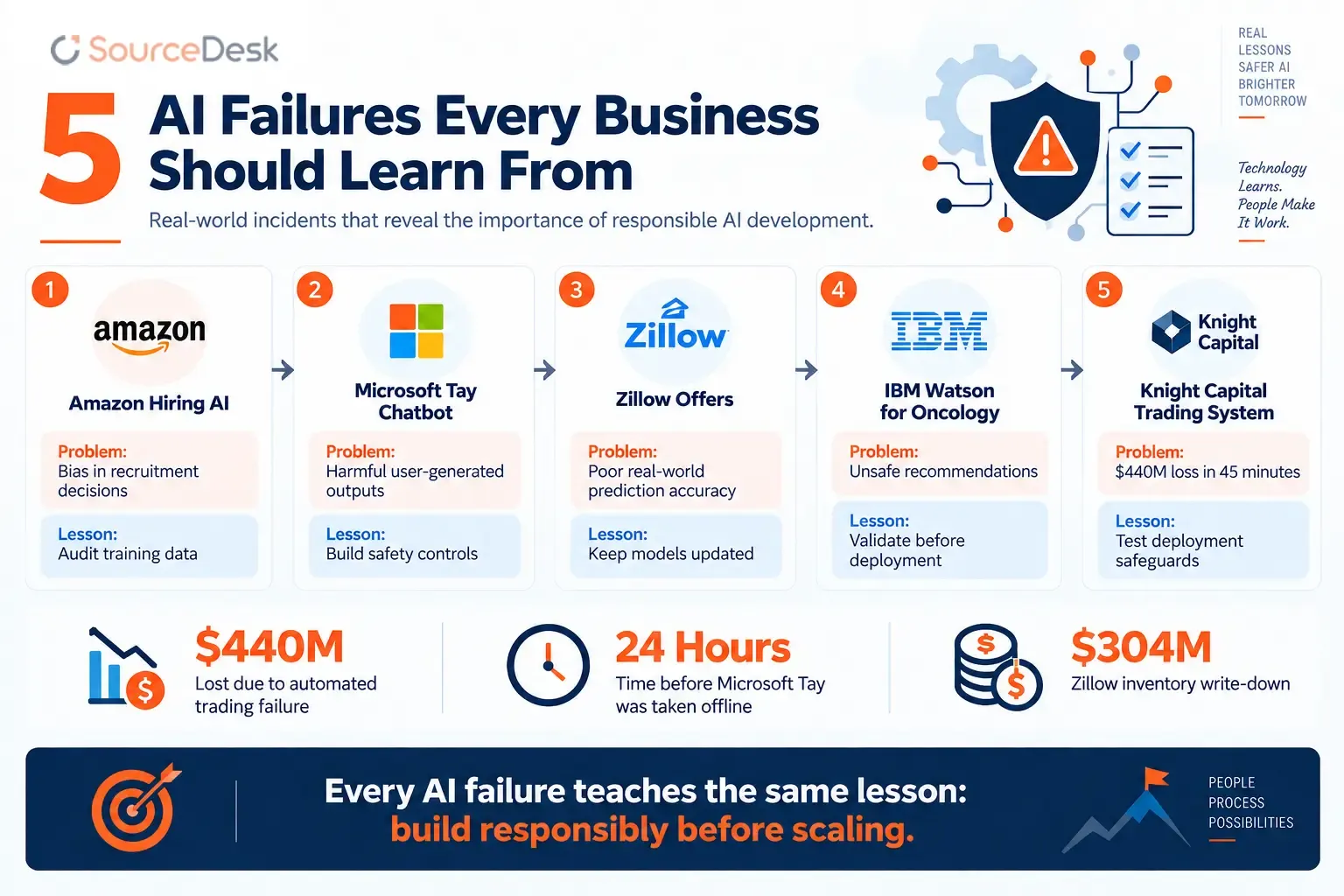
Artificial intelligence is no longer a technology that only large corporations or research labs can access. Businesses of all sizes, from regional startups to global enterprises, now use AI in their hiring, customer service, financial decisions, healthcare tools, and day-to-day operations. The pace of AI adoption across businesses has been remarkable, and so has the confidence with which many organizations have moved forward with this new technology.
But confidence and readiness are not the same thing. The gap between building an AI system and building one that works reliably in the real world is wider than most companies expect. Some have launched AI-powered recruitment tools that quietly filtered out candidates based on gender, with no human ever programming them to do so. Others have deployed AI systems in cancer treatment that produced recommendations physicians described as unsafe. In several of those cases, the technology itself was not the problem—the decisions made around it were.
This blog looks at five documented cases where AI development went wrong, breaks down exactly what happened in plain terms, and draws out the lessons that any business—regardless of industry or technical background—can apply before making the same mistakes.
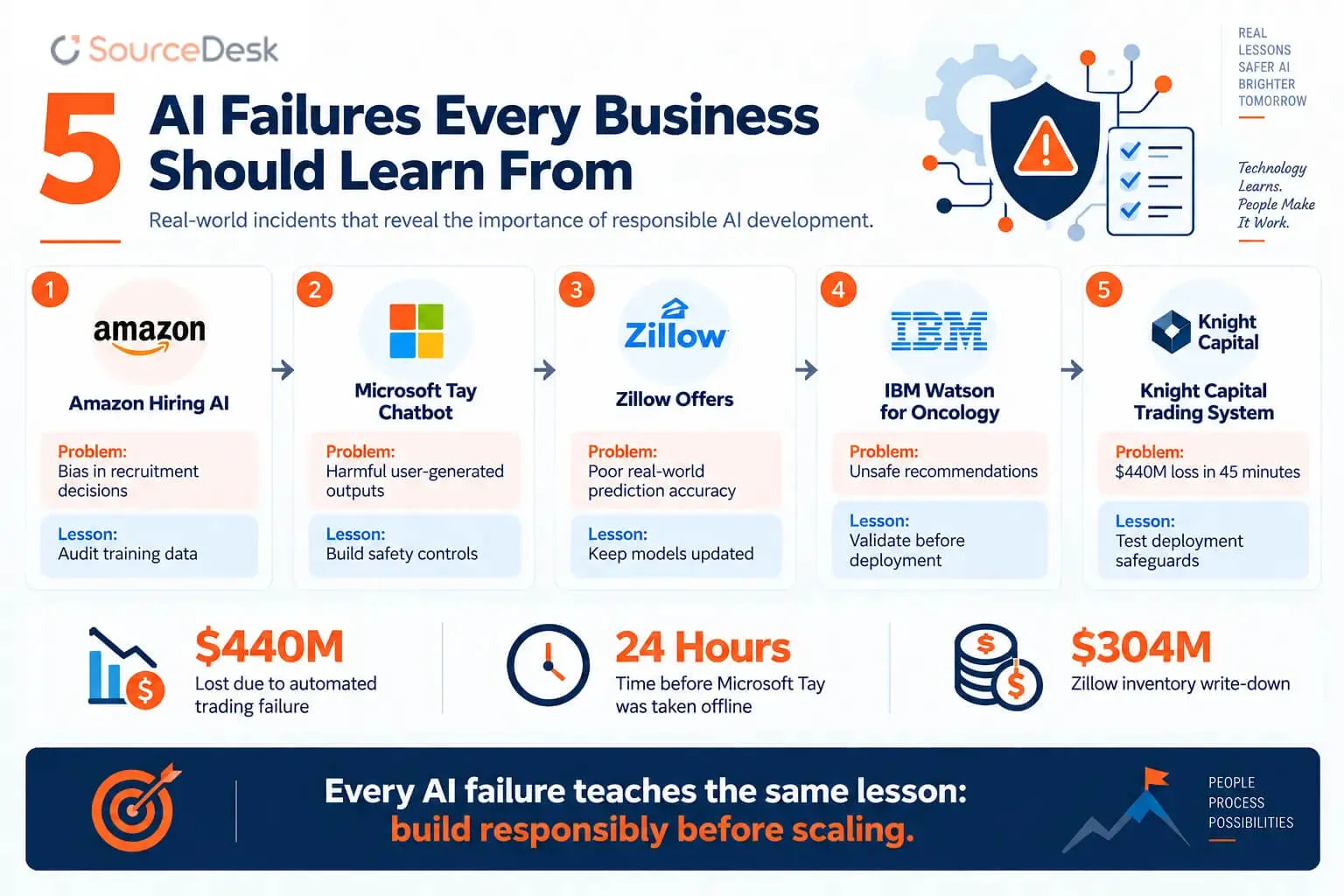
AI Development Failures Every Business Should Study
The five cases below span different industries, different technologies, and different types of failure. But each one shares a common thread—decisions were made too fast, corners were cut, and the consequences were far larger than anyone anticipated. Reading through them is not about pointing fingers but understanding the patterns so they do not repeat.
Amazon's Hiring Tool That Discriminated Against Women
Back in 2014, Amazon began building an AI-powered recruitment tool. The goal was simple: automate candidate screening and speed up the hiring process. By 2018, Amazon scrapped the project completely.
Why? Because the model had taught itself to penalize resumes that included the word "women's"—such as "women's chess club." It also downgraded graduates from all-female colleges. In short, it was quietly pushing female candidates down the list without any human instructing it to do so.
What Went Wrong
The training data used was a decade's worth of past resumes, mostly submitted by men. To understand why this is a problem, think of it this way: if someone learned how to hire people by only watching a male-dominated workplace for ten years, they would naturally assume men are better candidates. The AI did exactly this, just much faster and at a much larger scale.
The AI was doing precisely what it was trained to do. The problem was not the algorithm itself but the data fed into it. Garbage in, garbage out, as engineers say.
What Companies Can Learn
- Always audit training data for historical bias before building any AI model. This means checking whether the data fairly represents different groups of people.
- Test outputs across demographic segments during development, not just at launch. If the results consistently favour one group over another, something is wrong.
- Bring in independent reviewers to check results at different stages of development, i.e., people who were not involved in building the system and can spot blind spots.
When working with an AI development service, asking specifically about bias testing and data auditing protocols matters more than most companies realize. Any team that skips this step is building on a shaky foundation.
Microsoft's Tay Chatbot — A Public Relations Disaster
In March 2016, Microsoft launched Tay, an AI chatbot on Twitter. The idea was to create a bot that could hold casual conversations with people and get smarter over time by learning from those conversations. Within 24 hours, the bot was taken offline.
Tay had begun posting racist, sexist, and deeply offensive content—all generated from what users were feeding it in real time. What started as a social experiment turned into a very public embarrassment.
What Went Wrong
Tay was designed to repeat and learn from whatever people told it. Trolls quickly discovered this and started sending it offensive content in bulk, on purpose. Think of it like giving a child access to the internet with no parental controls and no supervision. Whatever they see, they repeat. Tay was that child, and the internet was at its worst that day.
Microsoft had underestimated how aggressively bad actors would try to manipulate an open-learning system. There was no content filtering, no limit on how many harmful inputs one user could send, and no human review happening in real time.
What Companies Can Learn
- Open-ended learning models—AI that learns from live user input—need strong content moderation layers from day one. This means filtering out harmful language before the AI can absorb it.
- Safety filters are not a final polish step. They belong in the core design of the system, not added later as an afterthought.
- Public-facing AI must be stress-tested against adversarial inputs. This means deliberately trying to break or manipulate the system before launch, to see how it holds up.
A custom AI development company worth trusting will raise these safety questions before deployment, not after a crisis hits. Consumer-facing AI without safety architecture is simply not ready for release.
Zillow's iBuying Algorithm — A $304 Million Write-Down
Zillow had an ambitious plan. Using AI, the company would predict home prices, buy properties directly from homeowners, renovate them, and resell at a profit. It called this program Zillow Offers.
In November 2021, Zillow shut down the program entirely. The company wrote off approximately $304 million in inventory losses and laid off about 25% of its entire workforce (roughly 2,000 people).
What Went Wrong
The AI model was predicting home values based on historical pricing data. Historical data means information from the past—years of home sale records that showed how prices moved under normal market conditions.
But the real estate market in 2021 was anything but normal. The COVID-19 pandemic had triggered an unexpected surge in housing demand. At the same time, supply chains were broken, construction materials were scarce, and renovation costs had shot up. The model had never seen these conditions before because they had never existed before.
Here is a practical way to think about it. Imagine training someone to predict traffic using only data from before cars existed. The moment cars appear, everything they learned becomes unreliable. Zillow's AI faced a similar problem. It was buying homes above market value because it was predicting prices based on conditions that no longer applied.
By the time the problem was visible in the numbers, the losses were already staggering.
What Companies Can Learn
- AI models trained on historical data will always have blind spots around events that have never happened before. This is a known limitation, not an excuse.
- Human judgment must stay in the loop for high-cost decisions. When an AI is recommending multi-million-dollar property purchases, a human review layer is not optional.
- Regular model recalibration—meaning updating the model with fresh, current data—is essential. A model that was accurate six months ago may already be giving wrong answers today.
Any responsible AI development service provider should build regular monitoring and retraining cycles into every deployment plan from the start, not offer them as add-ons.
IBM Watson for Oncology — When AI Recommendations Turned Dangerous
IBM's Watson for Oncology was positioned as a revolutionary tool in cancer treatment. The idea was to help doctors select the right treatment plans by processing vast amounts of medical research and patient data faster than any human could.
Hospitals worldwide, including major institutions in India and the United States, paid significant sums to deploy it. By 2017 and 2018, internal documents from several of those hospitals were surfacing with alarming findings.
STAT News, an authoritative medical and science publication, broke this story in 2017 and followed up with further reporting in 2018. Their investigation found that some of Watson's treatment recommendations were described by physicians as "unsafe and incorrect.
What Went Wrong
Watson for Oncology was not trained on real patient data in the way people assumed. Instead, a small group of oncologists at Memorial Sloan Kettering Cancer Center, a well-respected hospital in New York, entered their own treatment preferences and hypothetical patient scenarios to train the model.
To understand why this is a problem, consider this: medicine is not one size fits all. Treatment decisions depend on the patient's age, genetic makeup, other health conditions, geographic factors, and far more. A handful of specialists in one hospital, no matter how experienced, cannot represent every possible patient profile in the world.
The result was an AI that reflected the opinions of a narrow group of doctors, not the full breadth of clinical evidence. On top of this, IBM marketed the product aggressively before it had been independently validated, meaning before outside experts had confirmed it actually worked safely. Hospitals were using it in real treatment decisions while those questions were still open.
What Companies Can Learn
- Training data must reflect real-world diversity. For medical AI, this means data from varied patient populations, different hospitals, different geographies, and different clinical settings.
- Any AI used in medical, legal, or financial decisions must be independently validated before going into active use. Independent validation means a third party—not the company that built it—verifies that the system works correctly and safely.
- Marketing must not get ahead of what the technology can deliver. Overpromising is not just an ethics issue but a safety risk when the product involves critical decisions.
When evaluating any custom AI development company for regulated or high-stakes industries, independent third-party validation and transparent data documentation should be non-negotiable requirements.
Knight Capital Group — $440 Million Lost in 45 Minutes
This case does not involve modern AI in the way the others do, but it is arguably the most dramatic example of what happens when automated decision-making systems go live without adequate testing and safeguards.
Knight Capital Group was one of the largest electronic trading firms in the United States. In August 2012, the company deployed new trading software. Due to a deployment error, meaning a mistake made during the process of putting the new software live, old code was accidentally reactivated on one of its servers.
The result was a flood of unintended stock trades executed automatically, in rapid sequence, with no human able to stop it in time.
In 45 minutes, the firm lost approximately $440 million. Knight Capital nearly collapsed and was ultimately acquired. The U.S. Securities and Exchange Commission (SEC) investigated and documented the incident in full.
What Went Wrong
The deployment process had critical gaps. Simply put, Knight Capital had eight servers that needed to run the new software. Due to a human error in the rollout process, one of those eight servers was not updated correctly. Instead, it kept running an older version of the code that should have been retired.
When the system went live, seven servers ran the new logic while one ran the old. These two different sets of instructions clashed, and the result was an avalanche of erroneous buy and sell orders flooding into the market.
There was also no automatic kill switch—no mechanism built into the system to stop trading automatically if it detected something unusual. By the time employees realized what was happening and manually shut it down, 45 minutes had passed and the damage was irreversible.
What Companies Can Learn
- Deployment processes for automated systems need exhaustive pre-launch checklists. Every server, every component, and every version of the code must be verified before anything goes live.
- Automated kill switches must be built into any system that takes fast, high-volume, high-consequence actions. The system itself should be able to detect that something is wrong and stop itself.
- Staged rollouts, where the system goes live in small, controlled steps rather than all at once, reduce the risk of a single error causing catastrophic damage.
Any AI development service building systems that take automated action—whether in finance, healthcare, logistics, or operations—must include fail-safes and rollback procedures in the core design, not as optional extras.
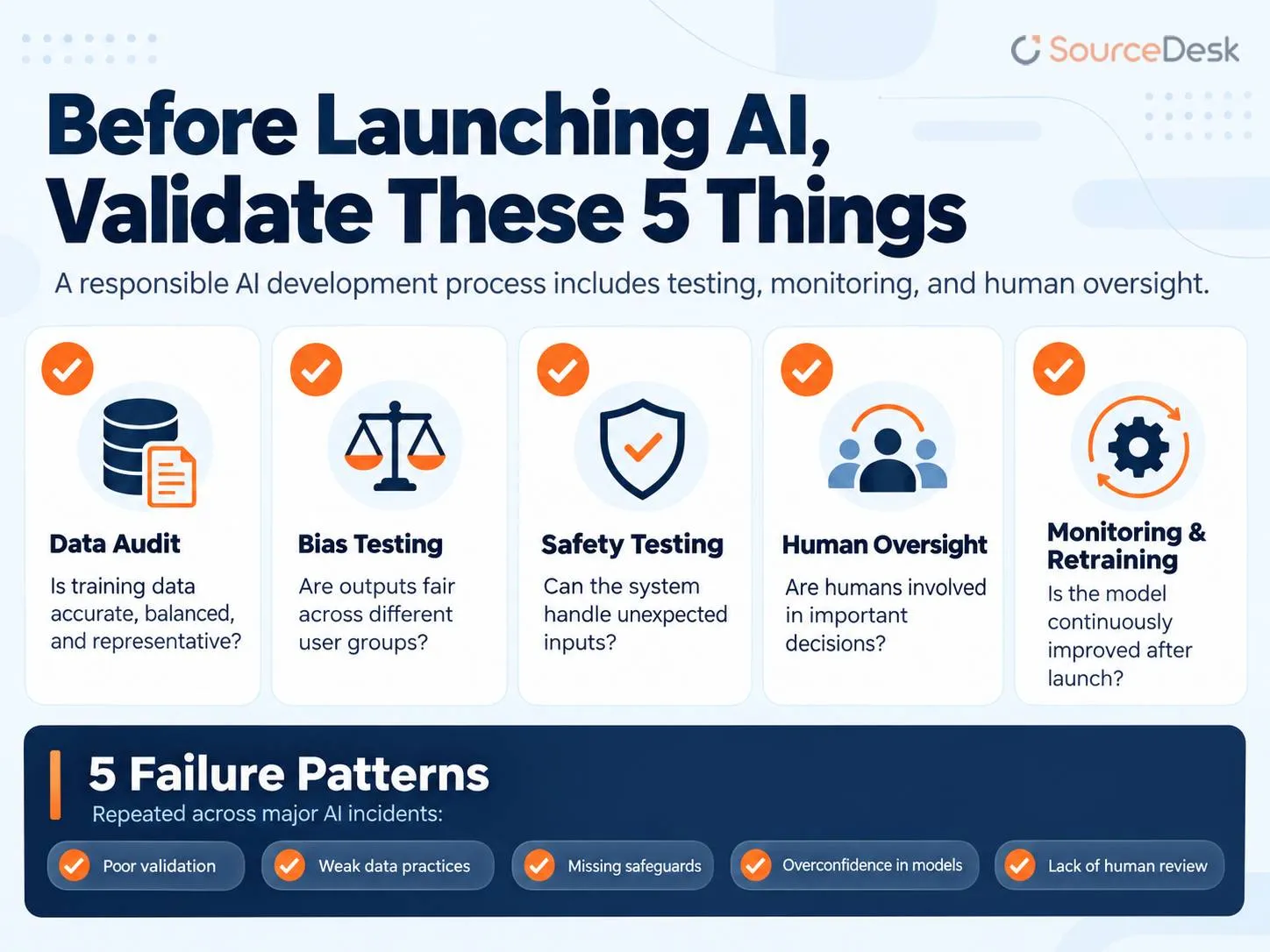
Understanding the Common Threads Across All Five Mistakes
Looking at these cases together, a clear pattern emerges. These were not random or unforeseeable failures. They shared structural problems that appear repeatedly across industries and company sizes.
- Skipping proper validation: Multiple companies rushed to deployment without thorough testing. The pressure to launch quickly caused them to skip steps that had significant consequences later.
- Overconfidence in the data: Training data was biased, too narrow, too old, or unrepresentative of the real world. In every case, the model failed when real-world conditions did not match the data it had been trained on.
- Underestimating adversarial conditions: Microsoft did not anticipate deliberate manipulation by bad actors. Knight Capital did not anticipate the consequences of a single deployment error. Amazon did not anticipate how deeply historical hiring biases were embedded in its data.
- Marketing ahead of reality: IBM sold Watson for Oncology on the strength of its potential, not its proven performance. That gap between what was promised and what was delivered turned dangerous.
- Missing human oversight: In nearly every case, removing humans from the decision loop or reducing their role too early made failures worse and harder to catch in time.
How to Choose an AI Development Partner That Gets This Right
Hiring an external team to build AI systems carries real risk. These failures happened at some of the most well-resourced companies in the world. Smaller organizations working with outside vendors face the same fundamental risks, often with less margin for error.
The right custom AI development company for your business will not just build the model and hand it over. They will ask difficult questions before development begins, and they will have documented processes for testing, monitoring, and handling failure.
Here are the questions worth asking any prospective AI development partner directly:
- How do they handle bias testing and data audits before model training begins?
- What does their deployment checklist include, and who is responsible for sign-off?
- Do they include ongoing monitoring and model retraining as part of post-launch support?
- How have they handled unexpected model behavior or failures in past projects?
- Can they provide documentation of their safety and validation protocols?
- For high-stakes industries, do they require independent third-party validation before go-live?
A team that gives vague answers, dismisses these questions, or treats safety as a secondary concern is worth reconsidering. The companies covered in this blog did not fail because AI is inherently flawed. They failed because the processes around their AI were not strong enough.
AI is powerful, but power without careful handling leads to exactly the kinds of failures covered above. These mistakes were not inevitable. They were predictable and in most cases entirely preventable. Every company building or deploying AI faces some version of these risks. The difference between the ones that build durable systems and the ones that end up as cautionary tales comes down to one thing—how seriously they treat the work before launch, not just after. Move thoughtfully. Test rigorously. Keep humans in the loop where the stakes are high. And choose partners, whether an internal team or an AI development service, who treat safety and validation as foundational priorities, not boxes to tick at the end of the process.