AI Consulting Services: How AI Strategy Consulting Helps Businesses Build Smarter, Scalable Solutions
By Prima Felicitas
6 Views
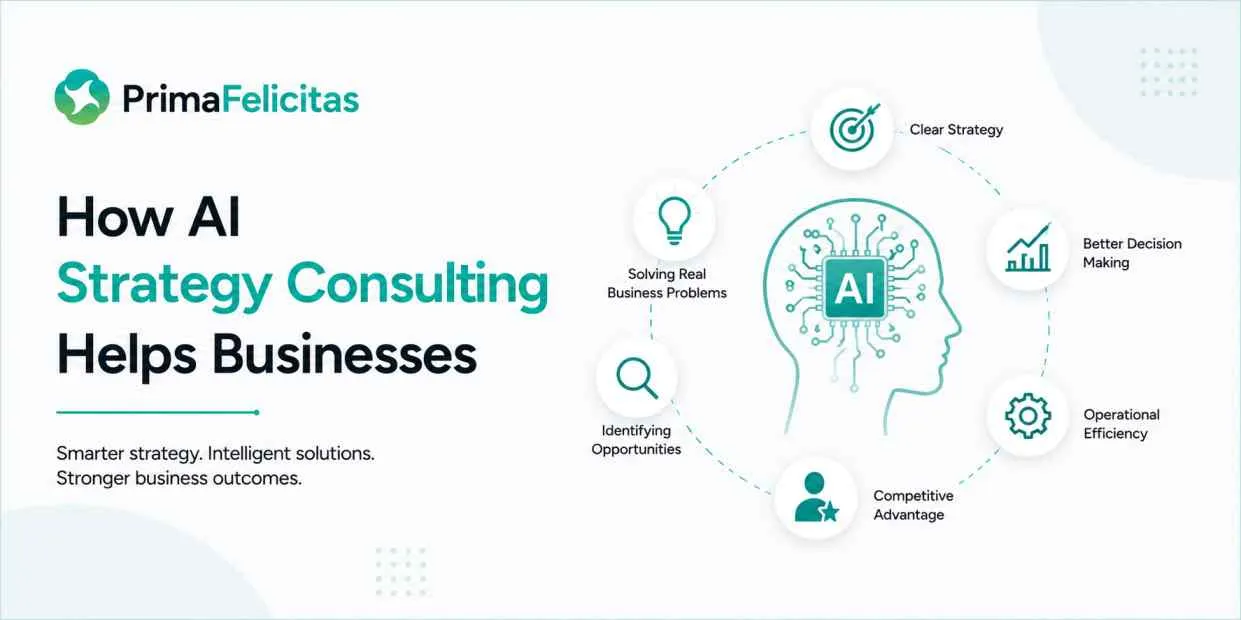
Artificial intelligence has moved far beyond being an experimental technology that businesses can simply watch from the sidelines. Today, companies across industries are exploring AI to improve customer experiences, automate repetitive work, analyze large volumes of information, strengthen decision-making, and create entirely new digital products. Yet there is a major difference between using an AI tool and building an AI capability that actually supports long-term business objectives. That gap is where AI consulting services become valuable. An experienced consulting partner can help a company identify realistic AI opportunities, evaluate its technology and data readiness, choose appropriate models and infrastructure, create an implementation roadmap, and establish governance around the systems it deploys. Current enterprise discussions are increasingly shifting from isolated AI experiments toward scalable systems, measurable outcomes, and stronger governance.
For a business leader, this shift creates an important question: where should AI actually fit into the organization? Buying another AI application may provide a short-term productivity boost, but it does not automatically create a sustainable AI strategy. AI strategy consulting takes a broader view by connecting technology decisions with business goals, operational workflows, customer needs, available data, budgets, and risk tolerance. The objective is not to add AI everywhere simply because competitors are doing it. Instead, the objective is to determine where AI can create meaningful value and then build the capabilities required to capture that value responsibly. This is why an effective AI consulting company operates more like a strategic guide than a software vendor. It helps organizations move from “We should use AI” to “Here is exactly where AI can create value, how we will implement it, how we will measure it, and how we will scale it.”
What Are AI Consulting Services?
AI consulting services are professional services designed to help businesses understand, plan, implement, and optimize artificial intelligence technologies according to their specific objectives. Depending on the organization, this may involve AI readiness assessments, business process analysis, machine learning strategy, generative AI implementation, data strategy, AI product development, automation, model selection, system integration, governance, and ongoing optimization. The important distinction is that consulting begins with the business problem rather than the technology. Instead of asking, “Which AI model should we use?” a consultant may first ask, “Which business process is creating the greatest cost, delay, risk, or customer frustration?” That simple change in perspective can dramatically improve the quality of an AI initiative.
Think of AI consulting as having an experienced architect before constructing a complex building. You would not purchase random materials and start building without understanding the land, structural requirements, budget, purpose, and future expansion plans. AI projects deserve the same discipline. A consulting team can examine existing systems, data quality, workflows, employee capabilities, security requirements, and business priorities before recommending a solution. This becomes especially important when an AI application needs to interact with sensitive information or critical operational systems. NIST's AI Risk Management Framework, for example, emphasizes managing AI risks throughout design, development, deployment, use, and evaluation rather than treating risk as something to consider only after deployment.
Why Businesses Need AI Consulting Today
The rapid growth of AI has created both opportunity and confusion. Businesses have access to powerful foundation models, AI assistants, automation platforms, predictive analytics tools, computer vision systems, and increasingly capable AI agents. The problem is that having more choices does not necessarily make decision-making easier. A company can easily spend money on disconnected tools, duplicate capabilities, expose sensitive data, or launch pilot projects that never make it into production. Current enterprise conversations increasingly emphasize moving from AI experimentation toward operational deployment, measurable outcomes, and organization-wide transformation.
This is where an AI consulting company can provide clarity. Consultants can help prioritize use cases based on business value and technical feasibility instead of hype. They can also help executives understand whether a problem requires a custom machine learning model, a generative AI application, an AI-powered workflow, an existing third-party platform, or perhaps no AI solution at all. That last option is important. Good consulting should not force AI into a process where conventional automation or better software would work more effectively. The strongest AI strategy is selective: it identifies the problems where intelligence, prediction, language understanding, pattern recognition, or autonomous decision support can provide a genuine advantage.
What Does an AI Consulting Company Do?
An AI consulting company typically works across several stages of the AI lifecycle, beginning with discovery and continuing through implementation and optimization. The first stage often involves understanding the organization's goals, pain points, customers, existing technology stack, data environment, and operational processes. From there, consultants can identify opportunities where AI may improve efficiency, reduce costs, increase revenue, strengthen decision-making, or create new customer experiences. Once promising opportunities have been identified, the consulting team can evaluate technical feasibility and develop a roadmap that considers investment, expected benefits, dependencies, security, compliance, and scalability.
The role becomes particularly valuable when a business has several potential AI opportunities but limited resources. Imagine a company considering AI-powered customer support, document processing, predictive maintenance, personalized recommendations, internal knowledge search, and automated reporting. Every idea may sound useful, but the company cannot realistically build everything at once. An AI consultant can rank these opportunities using criteria such as business impact, implementation complexity, data availability, time to value, risk, and strategic importance. This produces a prioritized portfolio rather than a random collection of experiments. The result is a more disciplined path from experimentation to production.
From Business Problems to AI Opportunities
A strong AI engagement starts with questions rather than assumptions. What consumes the most employee time? Which decisions depend on large amounts of data? Where do customers experience delays? Which manual processes repeatedly create errors? Which business activities could benefit from prediction, classification, personalization, natural-language interaction, or intelligent automation? These questions reveal opportunities that may not be obvious when leadership starts from technology rather than business needs.
Once opportunities are identified, they can be grouped into categories such as productivity, customer experience, operations, risk management, analytics, product innovation, and revenue generation. Each opportunity can then be assessed against expected value and implementation requirements. This process helps prevent a common mistake: choosing an impressive AI demonstration that has little connection to the organization's most important problems. AI should be treated as a capability that supports a business strategy, not as the strategy itself.
AI Strategy Consulting: Turning Ideas Into an Action Plan
AI strategy consulting transforms broad ambitions into a structured plan for adopting artificial intelligence. A strategy may define target use cases, technology architecture, data requirements, governance principles, talent requirements, investment priorities, implementation phases, and success metrics. It can also determine which capabilities should be developed internally and which should be obtained from external providers. The goal is to give decision-makers a clear picture of where the organization is today, where it wants to go, and what needs to happen between those two points.
A practical AI strategy should also account for organizational change. Introducing AI can alter workflows, employee responsibilities, approval processes, customer interactions, and even business models. A technically impressive system can fail if employees do not trust it, understand it, or know when they should override its recommendations. This is why successful AI transformation combines technology planning with people, processes, and governance. The best strategy is rarely the one with the most ambitious technology stack; it is the one that an organization can actually adopt, operate, measure, and improve.
Building a Practical AI Roadmap
A practical AI roadmap normally moves through several stages rather than attempting a massive transformation immediately. An organization might begin with an AI readiness assessment, select a small number of high-value use cases, build proofs of concept, validate expected outcomes, and then move successful solutions into production. Once the organization gains experience, additional use cases can be introduced using reusable architecture, governance standards, data pipelines, evaluation processes, and deployment practices.
This approach reduces unnecessary risk while creating momentum. It also allows leadership to learn from real-world implementation rather than relying entirely on theoretical forecasts. A roadmap should include measurable milestones, responsible owners, estimated investment, dependencies, and decision gates. When a pilot fails to deliver expected value, the organization should be able to stop or redesign it without losing an enormous investment. When a pilot succeeds, the architecture and processes should make it easier to scale.
Core AI Consulting Solutions for Modern Businesses
Modern AI consulting solutions can cover a wide range of capabilities because businesses use AI in very different ways. Some organizations need predictive analytics and machine learning, while others need generative AI applications, intelligent document processing, recommendation engines, conversational assistants, computer vision, fraud detection, forecasting, or autonomous workflow orchestration. A consulting partner may help evaluate these options and determine which technology is appropriate for a particular use case.
A mature consulting engagement can also connect multiple capabilities into a larger solution. For example, an enterprise knowledge assistant might combine document ingestion, data processing, retrieval, language models, access controls, monitoring, and human review. A customer-service platform might combine conversational AI with CRM data, workflow automation, sentiment analysis, analytics, and escalation mechanisms. These are not simply “AI models”; they are business systems with AI capabilities embedded inside them. Treating them as complete systems helps organizations consider reliability, security, usability, integration, and maintenance from the beginning.
AI Readiness and Technology Assessment
Before investing heavily in AI, businesses need to understand whether their existing environment can support the desired solution. AI readiness assessment can examine data availability, data quality, infrastructure, APIs, applications, security controls, technical skills, operational processes, and organizational maturity. A company may have excellent AI ideas but poor-quality or fragmented data, making implementation more difficult than expected.
The assessment provides a baseline from which an AI roadmap can be created. It can reveal where data needs to be cleaned, where systems need integration, which infrastructure needs modernization, and what skills the internal team may need. It can also identify quick wins that can generate early value while larger foundational improvements are underway. In this way, readiness assessment is not about finding reasons not to use AI; it is about making sure the organization is prepared to use it successfully.
Generative AI Consulting and Enterprise AI
Generative AI has expanded the range of business processes that can be supported by artificial intelligence. Instead of limiting AI to numerical prediction or structured classification, organizations can now build systems that work with natural language, documents, images, code, audio, and other forms of unstructured information. This creates opportunities for internal knowledge assistants, content workflows, software development support, document analysis, customer service, research, and many other applications.
Yet enterprise generative AI requires more than connecting an application to a language model. Businesses need to think about data privacy, hallucinations, access controls, evaluation, prompt and context management, model selection, costs, latency, monitoring, and human oversight. Current enterprise discussions also highlight the growing importance of moving AI from isolated pilots into governed production environments. An experienced consultant can help design an architecture where the model is only one component of a broader, controlled system.
AI Agents and Intelligent Automation
AI agents represent another important direction in enterprise AI. Rather than simply responding to a prompt, an agentic system may interpret a goal, plan multiple steps, interact with software tools, retrieve information, make decisions within defined boundaries, and complete portions of a workflow. This could potentially support tasks such as research, customer service, software operations, scheduling, document processing, or business analysis.
The opportunity is significant, but autonomy introduces additional considerations. What actions can an agent take? Which decisions require human approval? How is every action logged? What happens if the agent receives incorrect information? How can the organization prevent an automated system from accessing data or systems beyond its authorization? These questions demonstrate why agentic AI should be designed with governance and monitoring from the start rather than added after deployment.
AI Data Strategy and Model Selection
Data is the foundation on which most enterprise AI capabilities depend. An organization may have sophisticated models available to it, but poor-quality, incomplete, inaccessible, outdated, or improperly governed data can severely limit results. AI consulting solutions can therefore include data assessment, data architecture, data pipelines, knowledge-base design, data governance, and strategies for connecting AI applications with enterprise information.
Model selection is equally important. Businesses may choose between commercial foundation models, open-source models, specialized models, traditional machine learning approaches, or combinations of different technologies. The right choice depends on the use case, performance requirements, privacy considerations, infrastructure, cost, latency, regulatory environment, and desired level of customization. A consulting partner can help evaluate these trade-offs rather than assuming that the largest or newest model is automatically the best choice.
AI Implementation and System Integration
Moving from strategy to implementation is where many AI projects encounter their toughest challenges. A model can perform well in a controlled demonstration but deliver limited business value if it cannot connect reliably with the systems employees already use. AI implementation services can involve application development, API integration, workflow automation, data pipelines, cloud infrastructure, model deployment, monitoring, testing, and user-interface development.
Integration should be designed around the organization's actual workflow. If employees have to leave their existing systems, copy information manually, and enter results into another application, adoption may suffer. An effective AI solution should reduce friction rather than create another isolated destination. This is why AI consulting needs to combine technical architecture with user experience and process design.
Cloud, APIs, and Existing Business Systems
Enterprise AI commonly interacts with systems such as CRM platforms, ERP software, databases, document repositories, communication tools, analytics platforms, and internal applications. APIs and integration layers can connect these systems with AI services while preserving appropriate security boundaries. Depending on the workload, businesses may also use cloud infrastructure, private environments, local processing, or hybrid architectures.
The best architecture depends on the organization's requirements. Cloud deployment can provide flexibility and scalability, while local or private processing may be preferred for particular workloads involving sensitive information or strict operational requirements. Current discussions around enterprise AI increasingly emphasize balancing performance, cost, scalability, and security rather than assuming that one deployment model works for every workload.
AI Governance, Security, and Responsible AI
AI governance is becoming a core component of enterprise AI strategy rather than an optional add-on. Organizations need policies for data usage, model evaluation, access control, monitoring, human oversight, documentation, incident management, and accountability. These controls become even more important when AI is used for sensitive decisions or interacts with confidential business information.
NIST's AI Risk Management Framework organizes AI risk management around four functions: Govern, Map, Measure, and Manage. The framework is designed to support trustworthy AI across the system lifecycle, and NIST continues to develop and revise guidance as the AI landscape evolves. A responsible AI consulting approach can use such frameworks as reference points while tailoring governance to the organization's industry, risk profile, use cases, and regulatory environment.
Managing AI Risk and Compliance
AI risk is not limited to cybersecurity. Organizations may need to consider inaccurate outputs, bias, privacy exposure, intellectual property concerns, unreliable automation, insufficient transparency, model drift, vendor dependencies, and operational failures. Risk management should therefore involve technical teams, business leaders, legal professionals, security specialists, compliance teams, and other stakeholders where appropriate.
Governance also needs to be practical. A policy document sitting in a folder does little if employees do not understand how to apply it.
Effective governance translates principles into workflows, approval mechanisms, testing procedures, monitoring dashboards, documentation requirements, and clear accountability. NIST describes governance as a cross-cutting function that should influence the other AI risk-management activities throughout the lifecycle.
Benefits of Working With an AI Consulting Company
Working with an experienced AI consulting company can help organizations shorten the distance between an AI idea and a measurable business outcome. One major benefit is strategic clarity. Instead of chasing every new AI trend, companies can focus their investment on use cases aligned with revenue, efficiency, customer experience, risk reduction, or innovation goals. Consulting can also provide access to specialized technical knowledge when an internal team does not yet have expertise across AI architecture, data engineering, model evaluation, integration, security, and deployment.
Another benefit is reduced implementation risk. Experienced consultants can anticipate challenges that are easy to overlook during the excitement of a pilot project. They can help establish evaluation criteria, choose appropriate technologies, design integration architecture, create governance controls, and plan for scaling. The result is a more structured AI journey. Rather than building isolated experiments that eventually become technical debt, businesses can create reusable capabilities that support multiple future AI initiatives.
How AI Consulting Supports Different Industries
AI can be adapted to almost any industry, but the business case differs considerably from one sector to another. In healthcare, organizations may explore administrative automation, medical research support, documentation assistance, and patient engagement while paying close attention to privacy and safety. Financial institutions may use AI for fraud detection, customer support, risk analysis, document processing, and operational efficiency. Retail companies may explore personalization, demand forecasting, inventory optimization, customer service, and intelligent merchandising.
Manufacturing businesses can use AI for predictive maintenance, quality inspection, process optimization, robotics, and forecasting. Professional services firms may use AI for research, document analysis, knowledge management, and workflow automation. SaaS companies can embed AI directly into their products to create intelligent features and differentiated customer experiences. Across these sectors, the technology may look different, but the strategic principle remains similar: identify a meaningful business problem, determine whether AI is appropriate, build a solution around the workflow, and continuously measure its performance.
How to Choose the Right AI Consulting Company
Choosing an AI consulting company should involve more than comparing service pages or looking for the longest list of technologies. Businesses should examine whether a prospective partner understands their industry, business model, technical environment, and desired outcomes. Ask how the company approaches discovery, AI strategy, data assessment, architecture, security, implementation, testing, and post-launch optimization. A capable partner should be comfortable explaining both the opportunities and limitations of AI.
It is also useful to examine whether the consulting company can support the entire journey. A strategy-only firm may create a roadmap that another team must implement. A development-only company may build an application without addressing the broader organizational strategy. A partner capable of connecting AI strategy consulting, implementation, integration, governance, and optimization can provide greater continuity. Ultimately, the right partner should demonstrate that it understands business value—not simply that it knows how to work with AI technologies.
Measuring the ROI of AI Consulting Solutions
AI investments need measurable objectives. Depending on the project, useful metrics might include time saved per employee, reduction in manual processing, customer response time, conversion rate, operational cost, error rate, revenue generated, customer satisfaction, or employee productivity. The correct KPI depends on the use case. A customer-service assistant, for example, should not be evaluated using the same metrics as a predictive maintenance system.
ROI measurement should begin before implementation rather than after launch. Establishing a baseline makes it possible to compare performance before and after AI adoption. Organizations should also consider the total cost of ownership, including model usage, infrastructure, integration, monitoring, security, maintenance, employee training, and governance. This broader view helps leadership determine whether an AI system is actually delivering sustainable value rather than simply producing impressive demonstrations.
Common AI Consulting Mistakes to Avoid
One of the biggest mistakes is adopting AI because competitors are doing it. Another is choosing technology before defining the business problem. Companies can also underestimate data preparation, integration, security, employee adoption, and ongoing maintenance. A pilot that looks excellent in a controlled environment may behave differently when exposed to real-world users, messy data, changing requirements, and production workloads.
Another common mistake is treating AI governance as paperwork rather than an operational capability. Organizations should establish practical mechanisms for testing, monitoring, accountability, and human oversight. They should also avoid assuming that an AI system can simply be launched and forgotten. Models, data, business processes, regulations, and user expectations change over time. Successful AI therefore requires continuous evaluation and improvement.
The Future of AI Consulting Services
The future of AI consulting services will increasingly revolve around helping businesses operationalize AI at scale. The conversation is moving from “Can AI do this?” toward more practical questions such as “Can we deploy this safely?”, “Can employees adopt it?”, “Can we integrate it with our systems?”, “Can we measure the value?”, and “Can we scale it across the organization?” Current enterprise commentary reflects this transition from isolated experimentation toward governed, outcome-focused AI transformation.
AI agents, multimodal systems, domain-specific models, intelligent automation, and AI-native applications are likely to expand the range of business processes that can be redesigned. At the same time, organizations will need stronger controls around identity, data access, evaluation, monitoring, and human oversight. The consulting opportunity is therefore becoming broader: it is no longer simply about selecting an AI model. It is about designing the operating environment around intelligent systems.
Why AI Strategy Must Evolve Continuously
An AI strategy should never be treated as a document that is written once and placed on a shelf. Technology changes rapidly, model capabilities evolve, costs shift, regulations develop, competitors introduce new products, and customers change their expectations. A strategy that makes sense today may require adjustment six months from now. Continuous evaluation allows organizations to identify new opportunities while retiring solutions that no longer provide sufficient value.
This does not mean changing direction every time a new AI model is announced. Strategic flexibility is different from chasing trends. A strong organization maintains stable business objectives while remaining flexible about the technologies used to achieve them. That combination—clear goals with adaptable technology—is likely to become one of the defining characteristics of successful AI adoption.
How PrimaFelicitas Approaches AI Consulting
PrimaFelicitas AI Consulting Services can be positioned around helping businesses turn AI opportunities into practical technology initiatives. For organizations exploring AI Consulting Services, AI Consulting Company, AI Strategy Consulting, and AI Consulting Solutions, the focus should be on connecting business objectives with appropriate AI capabilities. A consulting engagement can begin with understanding the organization's challenges and identifying opportunities before moving into strategy, architecture, development, integration, and optimization.
The value of this approach is that AI becomes part of a larger business transformation rather than a disconnected technology experiment. Whether a company is evaluating generative AI, intelligent automation, predictive analytics, AI-powered applications, or enterprise AI integration, the implementation should be designed around measurable outcomes and long-term scalability. Businesses can then approach AI with a clearer roadmap, stronger technical foundation, and better understanding of the risks and opportunities involved. For organizations ready to explore what AI could mean for their products, operations, or customer experience, an experienced consulting partner can provide the strategic and technical direction needed to move forward with confidence.
AI is no longer simply a technology trend; it is becoming a strategic capability that can influence how organizations operate, serve customers, develop products, and make decisions. But successful adoption does not come from adding AI tools as quickly as possible. It comes from understanding business priorities, identifying high-value opportunities, preparing the right data and infrastructure, selecting appropriate technologies, integrating AI into real workflows, and establishing governance that keeps systems reliable and responsible.
That is the real purpose of AI consulting services. An experienced AI consulting company can help transform uncertainty into a structured roadmap, while AI strategy consulting connects technology investments with measurable business goals. With the right AI consulting solutions, organizations can move beyond isolated experiments and build intelligent capabilities that are scalable, secure, and useful in the real world. The businesses that benefit most from AI will not necessarily be those that adopt the most technology—they will be the ones that know where intelligence can create the greatest value and have the discipline to implement it well.
FAQs About AI Consulting Services
1. What are AI consulting services?
AI consulting services help organizations identify, plan, implement, and optimize artificial intelligence solutions according to their business objectives. Services can include AI strategy, readiness assessments, data strategy, generative AI consulting, machine learning, automation, integration, governance, and ongoing optimization.
2. Why should a business hire an AI consulting company?
An AI consulting company can help businesses avoid costly technology mistakes, prioritize valuable use cases, create an implementation roadmap, evaluate technical requirements, and connect AI initiatives with measurable business outcomes. This is especially useful for organizations that want to adopt AI but do not have all the required expertise internally.
3. What is AI strategy consulting?
AI strategy consulting focuses on determining how artificial intelligence should support an organization's broader business strategy. It can cover AI readiness, use-case prioritization, technology selection, data requirements, architecture, investment planning, governance, implementation, and success metrics.
4. What types of AI consulting solutions can businesses implement?
Businesses can explore solutions such as generative AI applications, AI chatbots, intelligent automation, predictive analytics, recommendation systems, computer vision, document intelligence, AI agents, fraud detection, forecasting, personalized experiences, and AI-powered software products. The appropriate solution depends on the organization's specific business problem and technical environment.
5. How can a business measure the success of an AI consulting project?
AI project success should be measured against predefined business KPIs. Depending on the use case, these may include productivity improvements, cost reduction, revenue growth, customer satisfaction, faster processing, reduced errors, improved forecasting, or increased operational efficiency. Establishing a baseline before implementation makes the resulting impact easier to evaluate.