How AI Is Changing Creative Testing for Performance Marketers in 2026
By Pallav
92 Views
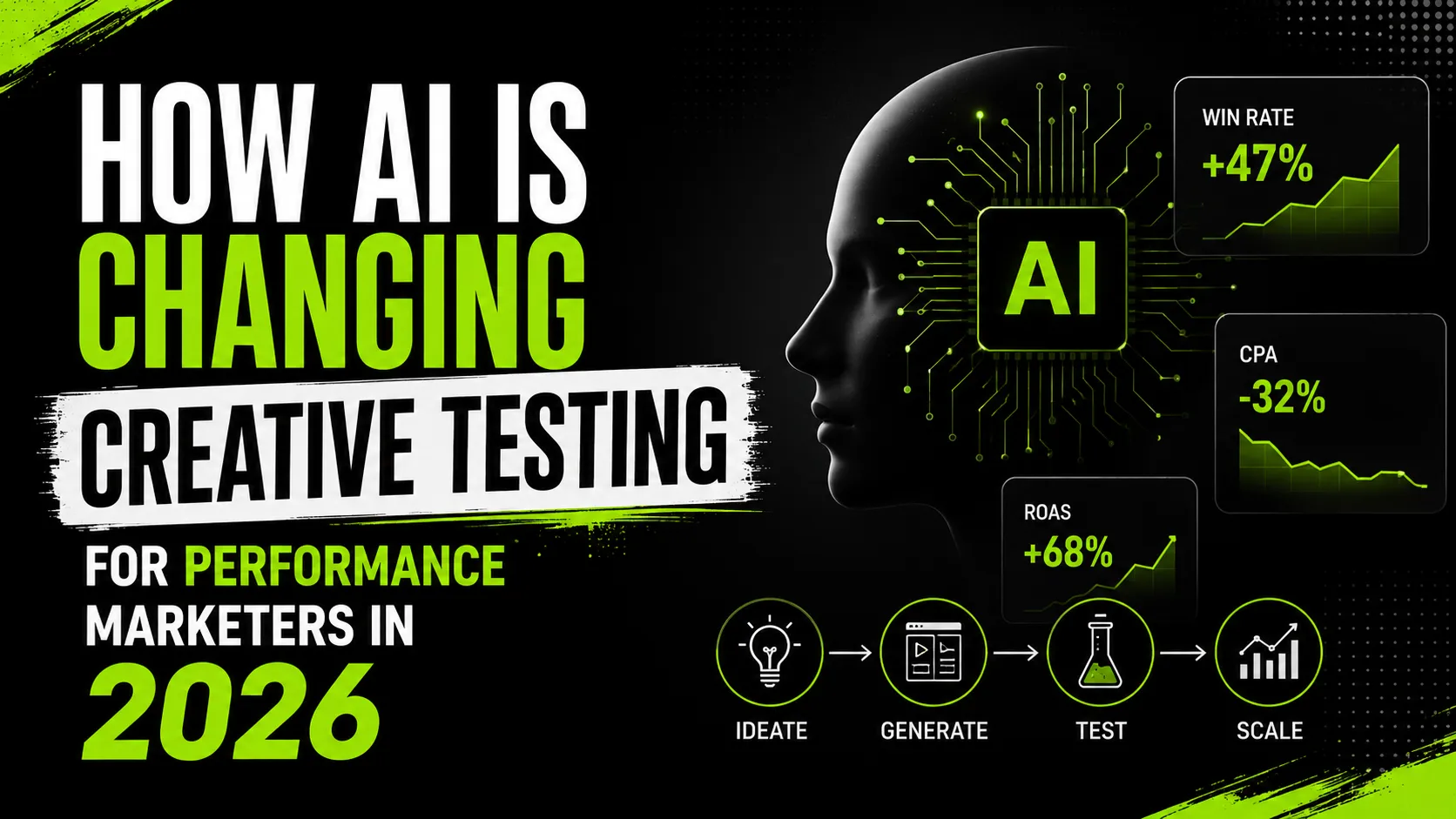
For most of the last decade, creative testing in performance marketing had a hard ceiling: you could only test as many ad variants as you could afford to produce. Production was the bottleneck, not ideas, not media budget, not even audience size. That ceiling has effectively disappeared over the last two years, and it's changing how testing itself gets done.
The old constraint: production speed
A typical creative testing cycle used to look like this: brief a creator or agency, wait days to weeks for delivery, launch a handful of variants, wait for results, then repeat. Even well-resourced teams were realistically limited to a handful of genuinely new creative concepts per month, because each one required real production time.
This constraint quietly shaped a lot of testing behavior. Teams tested fewer, bigger swings rather than many small ones, because each test was expensive in time and money. It also meant a lot of "testing" was really just re-skinning new faces, same script because producing a truly different creative concept was slower than producing a variation of an existing one.
What changed
AI video generation removed the production bottleneck without removing the need for genuine creative variation. A marketer can now generate a batch of structurally different ad concepts different hooks, different proof formats, different pacing in the time it used to take to brief a single creator. The constraint has shifted from "how fast can we produce this" to "how good is our hypothesis about what will perform."
That shift matters more than it sounds. When production was expensive, teams often defaulted to testing minor variations because a bold structural swing felt risky to commit real production budget to. When production is cheap and fast, testing a genuinely different concept costs almost nothing to try which means more of the actual testing budget goes toward learning what works, rather than toward simply producing content.
Structural cloning as a testing shortcut
One pattern that's emerged clearly in 2026 is structural ad-cloning taking the format of an ad that's already proven to convert (its hook placement, pacing, and scene structure) and applying that same format to a new product or offer, rather than writing a new script from scratch each time.
This isn't laziness; it's a reasonable response to how creative testing actually works. A format that's already validated carries real information about what an audience responds to. Starting from that format and changing only the product, the specific claim, or the visual context is a faster way to generate a plausible next test than starting from a blank page every time.
What hasn't changed
It's worth being honest about what AI hasn't solved. The quality of a testing program still depends entirely on the quality of the hypotheses behind each variant. Generating fifty videos that are all minor variations of the same weak idea produces fifty data points that tell you very little. The bottleneck has moved from production capacity to creative judgment knowing which structural levers are actually worth testing, and reading the results correctly once they come in.
Trust-heavy categories also haven't fully shifted. Supplements with medical claims, financial products, and anything relying on a founder's personal credibility still tend to perform better with a real presenter, at least for the hero creative in an account. AI production tends to work best for the high-volume testing layer underneath that hero ad, not as a wholesale replacement for it.
The practical shift for marketing teams
The teams getting the most out of this shift aren't the ones producing the most videos they're the ones who've restructured their testing process around the fact that production is no longer the limiting factor. That means:
- Testing genuinely different structural hypotheses, not just surface variations
- Checking hook-level engagement metrics early, since there's now enough volume to make that data meaningful within days rather than weeks
- Reserving real creator production for validated winners rather than unproven ideas
- Treating a large content library less like a finished deliverable and more like an ongoing experiment
The tools have gotten faster. The discipline required to use that speed well hasn't changed at all if anything, it matters more now that the excuse of "we don't have time to test more" is gone