Adding Depth to Laser-Cut Wood Art with Power Carving Techniques
By Kutzall
4 Views
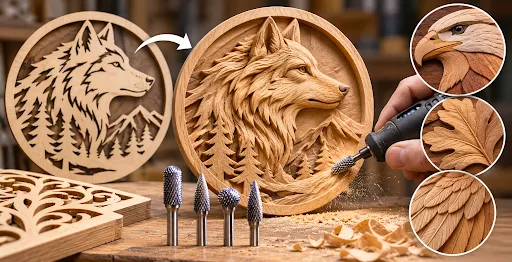
Laser cutters and scroll saws are unmatched when it comes to precision. They produce crisp outlines, fretwork, and fitted pieces. Yet their results often start out flat. That is why many makers are turning to power carving as a finishing step that adds dimension and character. Whether you are layering panels, building intarsia, or engraving signs, laser-cut wood art gains depth when contours, texture, and soft transitions are added by hand-controlled tools. This article explains why the combination works, what tasks power carving handles best, and which tool qualities matter, so your next project goes beyond a flat pattern.
From Flat Patterns to Dimensional Work
Scroll saws and laser cutters excel at accuracy, but power carving adds form and feeling. After pieces are cut or engraved, carving becomes the natural next step for shaping contours and soft transitions, adding texture such as fur or feathers, creating depth in portraits and wildlife scenes, and blending layered pieces seamlessly. It does not replace precision cutting. Instead, it enhances it, letting makers combine mechanical or digital accuracy with genuine artistic expression.
Why Makers Add Carving to Flat Projects
Cut pieces are flat by nature. Carving introduces dimension, realism, and surface character, which helps laser-cut wood art stand out visually and to the touch. Common applications include wildlife and portrait carving, relief and bas-relief panels, layered wall art and signage, fretwork with sculpted edges, decorative plaques and name signs, and engraved panels with added depth. Whether the goal is light texture or deep sculptural detail, carving expands what a flat pattern can become.
Bringing Intarsia to Life
Intarsia is a clear example of why carving matters. Individual flat segments are cut and fitted together, but power carving transforms them into flowing, dimensional forms. Makers shape curves, blend transitions between neighboring pieces, and create the illusion of depth and movement across the entire composition. From subtle shading to bold sculpted surfaces, the technique turns a two-dimensional pattern into a true work of art.
Cleaning Up Burn Marks and Edges
Laser cutting and engraving can leave charred edges, and scroll sawing leaves saw marks. Power carving is one of the most effective ways to clean up those marks, refine edges, and blend engraved areas naturally. Because it removes material gradually, it gives makers more control than sanding alone, which can reduce the risk of breaking thin or delicate parts when the tool is used properly.
Working at the Bench
Most projects are carved at the workbench, which gives complete control over grain direction, depth of cut, shading, and tight internal areas. Many makers use rotary tools or flex shafts, which offer the speed control and precision needed for detailed work without bulky equipment. Think of these tools as rotary chisels, delivering control that is hard to match with sanding alone. For laser-cut wood art in particular, this control matters on thin stock and engraved surfaces.
Qualities to Look for in Carving Tools
Not every tool suits detailed flat-stock work. Look for fine cutting control at low speeds, small profiles for detail, clean performance on both softwoods and hardwoods, and long tool life without clogging or burning. Compatibility with rotary tools and flex shafts matters, as does a smooth cutting action that minimizes tear-out. These traits matter most on thin stock, layered assemblies, and engraved surfaces, where predictable cutting keeps delicate work intact.
Burr Shapes and Grits
Burrs come in flame, taper, sphere, and dovetail shapes, and in fine, coarse, and very coarse grits. Fine grades suit shading and detail, while coarser grades remove material faster for shaping. Small shafts and compact heads fit detail work on thin stock.
Conclusion
Precision cutting and power carving work best together. Cutters and saws define the shape, while carving tools supply the depth, texture, and finish. Whether the goal is portraits, layered panels, or organic wood carving inspired by fur, feathers, and flowing forms, a steady hand and the right tool make the difference. Practice control, and each project will gain dimension.
Related Reading
Expert Insights: Navigating the Complex World of Home Improvement
Welcome to our in-depth exploration of Home Improvement. In an era defined by ra...
Why Home Improvement is Transforming the Global Industry Landscape
Welcome to our in-depth exploration of Home Improvement. In an era defined by ra...