Understanding Daily Calorie Needs
93 Views
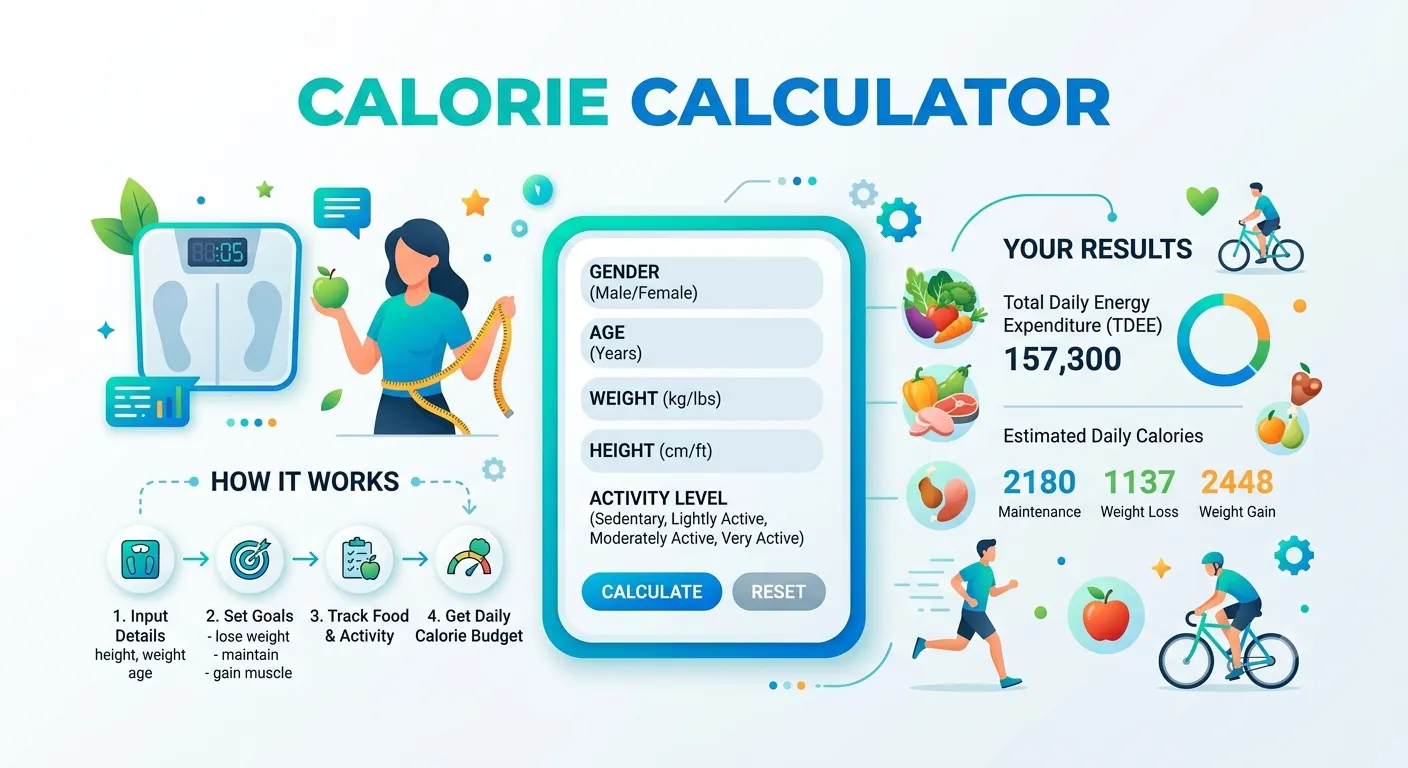
Figuring out how many calories your body actually needs each day is one of the most useful first steps in any health, weight loss, or fitness journey. Instead of guessing or relying on generic advice, you can use a Calorie Calculator to get a personalized daily calorie estimate based on your age, gender, weight, height, and activity level in just a few seconds.
Understanding Daily Calorie Needs
What is a calorie calculator?
A calorie calculator is a tool that estimates the number of calories your body burns in a day, known as your Total Daily Energy Expenditure (TDEE). It combines your Basal Metabolic Rate (BMR), which is the energy your body needs at complete rest, with an activity multiplier that accounts for exercise, walking, work, and daily movement. The result gives you a realistic number to work from, whether your goal is to lose weight, gain muscle, or simply maintain your current body composition.
Why does calorie need vary so much between people?
Calorie needs differ because of factors like age, biological sex, muscle mass, height, and daily activity levels. A younger person with more muscle tissue typically burns more calories at rest than an older person with less muscle mass, even if they weigh the same. Taller individuals also tend to have higher energy requirements because their bodies have more tissue to maintain. This is why generic calorie recommendations, like a flat 2,000 calories a day, often do not reflect what an individual body actually needs.
How Calorie Calculators Work
What formulas do calorie calculators use?
Most calorie calculators rely on the Mifflin-St Jeor equation or the Harris-Benedict equation to estimate BMR. The Mifflin-St Jeor formula is generally considered more accurate for modern populations and is widely used in clinical and fitness settings. Once BMR is calculated, it gets multiplied by an activity factor, ranging from sedentary to extremely active, to produce the final daily calorie estimate. Some advanced calculators also factor in body fat percentage for even greater precision.
How does activity level affect the final number?
Activity level plays a major role in the final calorie estimate because it accounts for calories burned through movement beyond basic bodily functions. A sedentary office worker who rarely exercises will have a much lower calorie need than someone who trains five times a week or has a physically demanding job. Calculators typically offer categories such as sedentary, lightly active, moderately active, very active, and extremely active, allowing users to select the option that best matches their lifestyle for a more accurate result.
Using Calorie Numbers for Your Goals
How many calories should I eat to lose weight?
To lose weight, you generally need to eat fewer calories than your body burns, creating what is known as a calorie deficit. A moderate and sustainable approach is to reduce your daily intake by around 500 calories below your maintenance level, which can lead to gradual, steady weight loss over time. Cutting calories too drastically can lead to muscle loss, nutrient deficiencies, and difficulty sticking to the plan long term, so a measured approach tends to produce better lasting results.
How many calories should I eat to gain muscle or weight?
Gaining weight or building muscle requires eating more calories than your body burns, known as a calorie surplus. A modest surplus of around 250 to 500 calories above maintenance, combined with adequate protein intake and resistance training, supports muscle growth while limiting excess fat gain. Eating in a much larger surplus may speed up weight gain, but a significant portion of that gain is likely to come from fat rather than lean muscle tissue.
Practical Tips for Accurate Results
How can I get the most accurate calorie estimate?
To get the most accurate estimate, be honest about your activity level rather than overestimating how active you are, since this is one of the most common sources of error. It also helps to recalculate your calorie needs periodically, especially after significant weight changes, since your BMR shifts as your body composition changes. Tracking your actual food intake alongside your calculated target for a few weeks can help you fine-tune the number based on real-world results.
Should I rely only on the calculator's number?
While a calorie calculator provides a strong starting point, it is still an estimate rather than an exact measurement, since factors like metabolism, hormones, and genetics can cause individual variation. It is a good idea to treat the result as a baseline, monitor your progress over a few weeks, and adjust your intake slightly up or down based on how your body actually responds. Pairing the calculator's estimate with consistent tracking gives you the most reliable path toward your goal.