9 Reasons English Spelling Is So Confusing, Explained Simply
60 Views
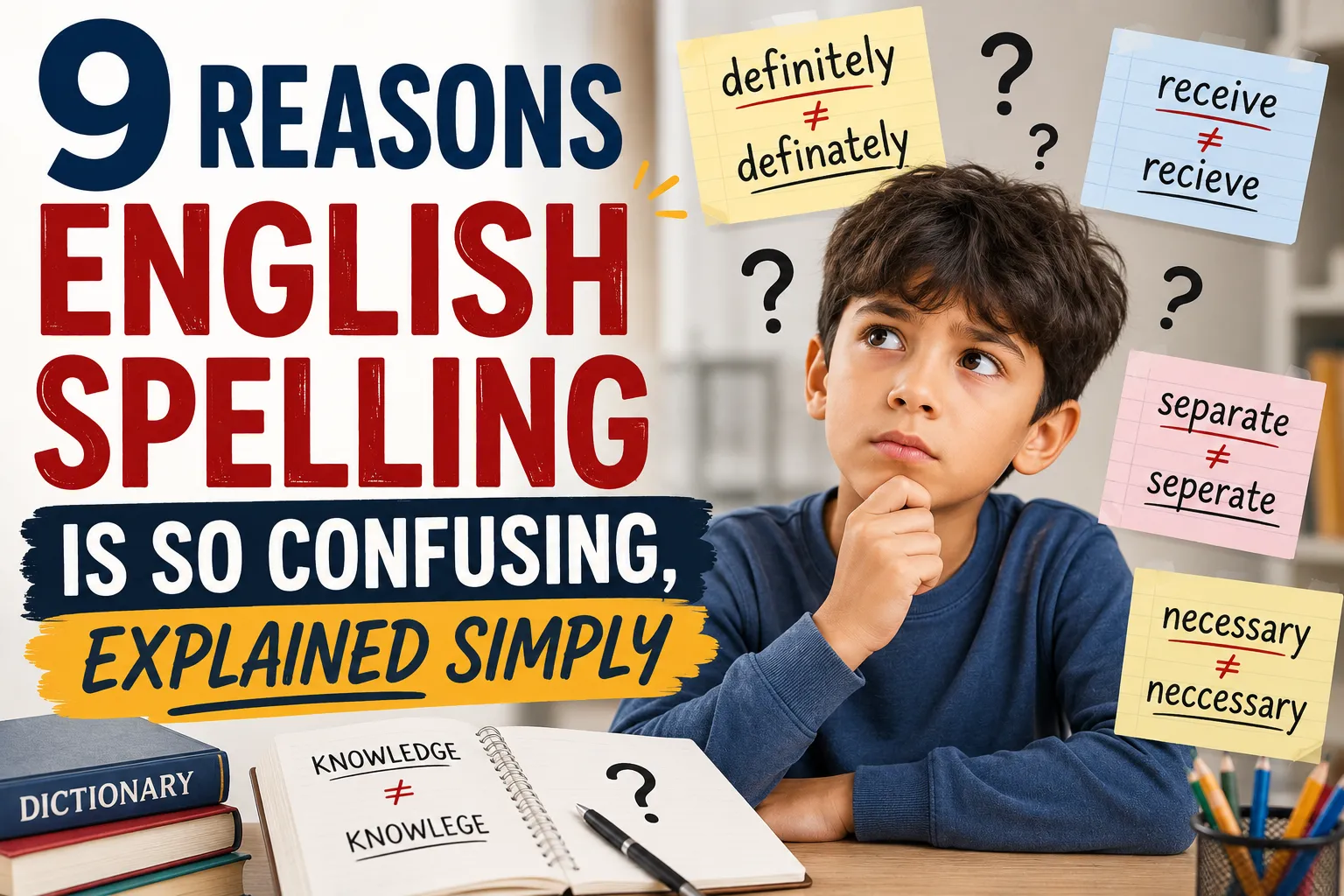
Ask any adult learning English, or any parent watching their child stumble over “though,” “through,” and “tough,” and you’ll hear the same complaint: English spelling makes no sense. And honestly, they’re not wrong. Unlike languages such as Spanish or Finnish, where a letter almost always makes the same sound, English is famous for breaking its own rules. Here are nine simple reasons why.
1. English borrowed words from everywhere
English isn’t one language wearing a single set of spelling rules. It absorbed vocabulary from Old Norse, French, Latin, Greek, and dozens of other sources over centuries of invasion, trade, and academic borrowing. Each source brought its own spelling habits along with it, which is why “ballet” looks nothing like “bat,” even though both end in a single consonant sound.
2. The Great Vowel Shift changed pronunciation but not spelling
Between the 1400s and 1700s, English vowel sounds shifted dramatically. Words kept their original spelling from before the shift, but the way people said them changed completely. That’s a large part of why “name” isn’t pronounced the way it’s spelled, and why so many long vowels feel unpredictable.
3. Printing arrived before spelling was standardized
When the printing press reached England in the 1470s, spelling wasn’t yet fixed. Printers, many of them trained abroad, made their own choices, sometimes stretching a word to fill a line of type. Some of today’s odd spellings are leftovers from these early printing decisions rather than any spoken logic.
4. Silent letters preserve history, not sound
Letters like the “k” in “knight” or the “b” in “debt” once had a purpose. Either they were pronounced, or they were inserted later to show a word’s Latin origin. They stayed in the spelling long after they stopped being useful for pronunciation, a pattern covered in more depth in Fonetic English's overview of the history of English and its erratic spelling system.
5. One letter can represent many sounds
Take the letter “a.” It sounds different in “cat,” “father,” “cake,” and “any.” There’s no single rule that tells a learner which sound applies where, so they end up memorizing exceptions one word at a time instead of applying one consistent pattern.
6. One sound can be spelled many ways
The reverse problem is just as common. The “sh” sound appears in “shoe,” “sugar,” “mission,” and “nation,” each spelled differently. A learner who masters one spelling pattern still has three or four more versions of the same sound waiting to trip them up.
7. Regional dialects froze into “correct” spelling
Standard English spelling locked in based on the dialects spoken in and around London centuries ago. Words that made phonetic sense in that regional accent don’t necessarily make sense in how English is spoken today, in Australia, India, the US, or anywhere else. The spelling froze; the pronunciation kept evolving.
8. Grammar rules complicate spelling further
Plurals, tenses, and prefixes all add their own layer of irregularity. “Child” becomes “children,” not “childs.” “Go” becomes “went,” not “goed.” These grammatical exceptions get memorized separately from phonics rules, adding yet another category of words a learner simply has to know.
9. English keeps evolving, but spelling barely does
New words enter English constantly, borrowed, invented, or shortened, and while pronunciation adapts quickly, spelling conventions move far more slowly. This growing gap is one reason English is considered harder to learn to read than many other languages, since a learner can’t fully rely on sounding a word out.
The takeaway
None of this means English is impossible to learn. It just means spelling can’t be taught the way it might be in a more phonetically consistent language, where sounding a word out reliably gets you to the correct spelling. Understanding these patterns, rather than treating every irregular word as a random exception to memorize in isolation, makes the whole system far less intimidating for both children and adult learners. Once a learner sees why a word is spelled the way it is, whether that's a borrowed root, a silent historical letter, or a leftover printing-press choice, the irregularity stops feeling arbitrary and starts feeling explainable.
Related Reading
Expert Insights: Navigating the Complex World of Education & Learning
Welcome to our in-depth exploration of Education & Learning. In an era defin...
Why Education & Learning is Transforming the Global Industry Landscape
Welcome to our in-depth exploration of Education & Learning. In an era defin...