7 Strategic Benefits of Outsourcing Content Writing in 2026
By Amir
49 Views
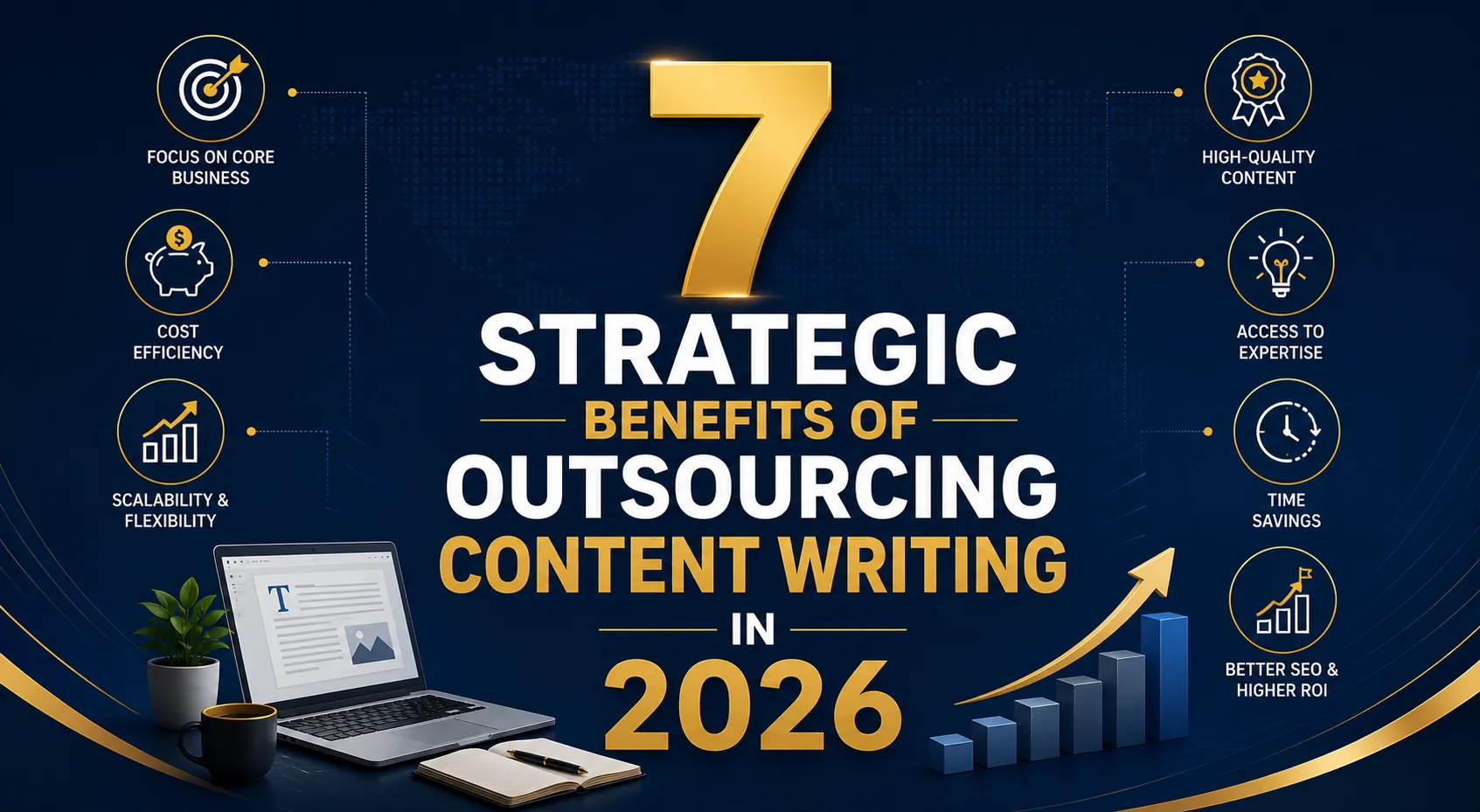
Outsourcing content writing in 2026 lets you scale high-quality, SEO-optimized content faster and cheaper while freeing your team to focus on strategy and revenue. This guide breaks down seven strategic benefits, a practical decision framework, and how AI search monitoring can sharpen your entire SEO plan.
If you are a B2B founder, marketing lead, or agency owner trying to grow organic traffic without bloating your headcount, this post is for you. It goes beyond generic advice and gives you a clear playbook to decide when to outsource, what to outsource, and how to measure ROI in a world where AI answer engines now share the stage with traditional search.
The 2026 Reality Check: Why Just Hire More Writers No Longer Works
Content needs in 2026 are different. You are not just writing for Google blue links. You are writing for AI Overviews, ChatGPT, Perplexity, and other generative engines that synthesize answers instead of just listing pages. Over half of Google searches now end without a click, which means traditional rank tracking captures only part of your real visibility.
At the same time, quality now matters more than sheer volume. Old advice said publish as much as possible. New data shows that strategic, entity-rich, and well-structured content outperforms thin posts, even if you publish less often.
Most internal teams cannot simultaneously:
- Keep up with the volume needed to compete
- Maintain deep niche expertise across topics
- Optimize for both classic SEO and generative engine optimization (GEO)
That is where outsourcing becomes strategic, not just tactical.
7 Strategic Benefits of Outsourcing Content Writing in 2026
1. Specialized Expertise on Demand Without the Headcount
Outsourcing gives you instant access to writers who already understand your niche, whether that is SaaS, fintech, healthcare, or industrial B2B. These writers bring industry vocabulary, common objections, and real-world use cases that generic in-house writers often miss.
In 2026 this matters more than ever because AI search rewards authority and factual density. Models are more likely to cite content that clearly demonstrates expertise, uses structured data, and aligns with recognized entities in your space.
How to implement:
- Create a writer to niche matrix. Map your main topic clusters to writers who have proven experience in those areas.
- Require samples that show depth, not just style. Look for pieces that include data, frameworks, or original insights.
- Ask vendors how they handle GEO tasks like schema, entity alignment, and citation-friendly structures.
On marketing forums like Reddit, many B2B teams report that specialized outsourced writers produce content that ranks faster and earns more backlinks because it speaks directly to buyer pain points and uses the right technical language.
2. Scalable, Consistent Content Production
One of the most cited benefits of outsourcing is the ability to scale output without burning out your internal team. Agencies and managed services can move from one post per month to multiple posts per week once their process is dialed in.
Consistency is critical for SEO. Search engines and AI systems both favor sites that regularly publish fresh, relevant content and update older posts to reflect new information.
How to implement:
- Set a realistic publishing cadence and tie it to a sprint-based calendar. For many B2B brands, 4 to 8 high-quality posts per month is a strong starting point.
- Use a clear workflow: brief, outline, draft, edit, optimize, publish, refresh. Outsourced teams thrive when the steps are explicit.
- Track content velocity and quality side by side. Do not sacrifice depth just to hit a number.
Case studies from content agencies show that clients who move from sporadic publishing to a consistent schedule often see organic traffic growth within 90 days, especially when they combine new posts with strategic updates to existing content.
3. Faster Time to Rank Through SEO-First Workflows
Outsourced SEO content teams do not just write words. They build content around keyword research, search intent, internal linking, and content clusters. This SEO-first approach shortens the time it takes for new pages to rank and earn traffic.
In 2026, this also means optimizing for AI Overviews and generative citations. Content that is easy for models to extract and cite tends to gain visibility even when it does not always hold position one in traditional SERPs.
How to implement:
- Require a content brief for every piece. This should include primary and secondary keywords, search intent, target entities, and a proposed internal link map.
- Build content clusters around core topics instead of isolated posts. This signals topical authority to both search engines and AI models.
- Include a refresh plan. Ask your vendor to revisit high-potential posts every 60 to 90 days to add new data, examples, and sections that match current search behavior.
Professionally outsourced SEO content can significantly raise rankings in SERPs and deliver measurable organic growth, especially when paired with strategic keyword integration and strong content structure.
4. Cost Efficiency With Predictable Budgets
Hiring full-time writers is expensive. You pay salary, benefits, tools, and management time. Outsourcing converts many of these fixed costs into variable costs you can scale up or down as needed.
For small and mid-sized B2B companies, this is often the difference between running a serious content program and posting once in a blue moon. Outsourcing lets you access top-tier writing and SEO expertise on a project or retainer basis without the overhead of a full in-house team.
How to implement:
- Build a simple cost model. Compare fully loaded in-house cost per writer against vendor pricing per asset or per hour.
- Define your target cost per post by quality tier. For example, standard blog posts versus long-form guides versus thought leadership pieces.
- Start with a pilot. Run 4 to 6 pieces with a vendor, measure results, then decide whether to scale.
Many teams find that outsourcing reduces cost per article while improving quality, because specialized writers produce stronger drafts that need fewer revision cycles.
5. Fresh Angles That Beat Competitor Content
Internal teams often develop tunnel vision. They know the product deeply but may miss the bigger market narrative, emerging trends, or competitor angles. External writers bring fresh perspectives and experience across multiple brands and industries.
This is crucial in 2026 when AI search amplifies content that stands out. Generic, rehashed posts get buried. Content with unique frameworks, original data, or contrarian insights gets cited and shared.
How to implement:
- Mandate a unique insight section in every brief. This could be a mini case study, a data snippet, a quote from an expert, or a new framework.
- Ask writers to review top 10 ranking pages and identify gaps. What questions are not answered fully? What examples are missing?
- Encourage writers to pull from diverse sources, including Reddit threads, niche communities, and customer interviews, to add real-world texture.
On Reddit marketing and SEO threads, many practitioners note that content which references real discussions, includes specific numbers, and avoids fluff tends to perform better both in traditional search and AI summaries.
6. Operational Focus: Let Your Team Own Strategy, Not Just Words
When execution is outsourced, your internal marketers can focus on what they do best: positioning, offers, distribution, and conversion. They become strategists and editors instead of full-time writers.
This shift aligns with how modern SEO works. Strategy and distribution matter more than raw word count. A smaller set of well-placed, well-promoted pieces often outperforms a large volume of orphaned posts.
How to implement:
- Define clear ownership. Your team owns messaging, product narrative, and final editorial sign-off. The vendor owns research, drafting, and on-page SEO.
- Build a lightweight governance model. Weekly syncs, shared dashboards, and a simple approval workflow keep everyone aligned.
- Use your internal team to drive promotion. They can repurpose content into LinkedIn posts, newsletters, webinars, and sales enablement assets.
This division of labor lets you move faster and with more focus. Your team spends less time churning words and more time turning content into pipeline.
7. Measurable ROI and Transparent Performance Loops
Good outsourcing partners do not just deliver drafts. They tie their work to outcomes. They track rankings, organic traffic, engagement, and when possible, leads and revenue influenced by content.
In 2026, this also means tracking AI visibility. Are you being cited in AI Overviews and generative answers? How often does your brand appear when prospects ask relevant questions in ChatGPT or Perplexity? These are becoming real SEO metrics.
How to implement:
- Set clear KPIs from day one. Examples include organic sessions, ranking improvements for target keywords, and content-driven demo requests or form fills.
- Require monthly reporting. Ask for a simple dashboard that shows what changed, what worked, and what needs adjustment.
- Add AI visibility metrics if possible. Citation share, share of model, and presence in AI answers give you a fuller picture of visibility beyond clicks.
Agencies that adopt this approach report faster optimization cycles. They can see which topics and formats drive results and double down on what works instead of guessing.
The 2026 Outsourcing Decision Framework
Not every company should outsource everything. Use this simple scorecard to decide how much of your content operation to keep in-house versus outsource.
Outsource Scorecard (0 to 10)
Rate each item from 0 to 2:
- Content volume gap: How far behind are you on your ideal publishing cadence?
- 0: On track
- 1: Slightly behind
- 2: Significantly behind
- Niche expertise gap: Do you lack writers who deeply understand your space?
- 0: Strong internal expertise
- 1: Some gaps
- 2: Major gaps
- Internal bandwidth: How much time does your team actually have for content?
- 0: Plenty of time
- 1: Limited time
- 2: Almost no time
- Budget flexibility: Can you allocate a monthly budget for content?
- 0: Very tight
- 1: Some flexibility
- 2: Clear budget available
- Quality consistency issues: Is your current content inconsistent or underperforming?
- 0: Consistent and strong
- 1: Mixed results
- 2: Frequent quality problems
Interpretation:
- 0 to 3: Keep most content in-house. Outsource only specific tasks like guest posts or content refreshes.
- 4 to 6: Hybrid model. Keep strategy, core messaging, and flagship pieces in-house. Outsource execution for blogs, SEO pages, and refresh cycles.
- 7 to 10: Strong case to outsource the majority of content production. Keep internal oversight and final editorial control.
Example: A B2B SaaS company that is behind on publishing, lacks niche writers, and has a tight team but some budget might score 8. That suggests outsourcing most blog and SEO content while keeping product narratives and case studies in-house.
This framework is more practical than generic advice because it forces you to quantify your situation instead of guessing.
What to Outsource and What to Keep In-House in 2026
Outsourcing everything is rarely optimal. The best results come from a thoughtful split.
Outsource These
- Blog posts and SEO articles
- Content refreshes and updates
- Guest posts and contributor articles
- Long-form guides and pillar pages
- Product-led content that does not require deep internal access
These tasks benefit from specialized writers, structured workflows, and SEO expertise. They are also easier to brief and QA without constant internal involvement.
Keep In-House
- Core messaging and positioning
- Sensitive case studies and customer stories
- Product documentation that requires deep internal knowledge
- Final editorial sign-off and brand voice guardianship
Your team knows your product, customers, and market nuances better than any vendor. Use that advantage to guide the narrative and ensure accuracy.
A simple way to think about it: outsource execution, keep strategy and voice.
Avoiding the 3 Big Outsourcing Risks in 2026
Outsourcing is powerful, but it comes with risks. Address them upfront.
1. Brand Voice Drift
When multiple writers contribute, your content can start to sound fragmented. This weakens brand perception and reduces trust.
Mitigation:
- Create a clear voice guide with examples of good and bad lines.
- Approve a sample article before scaling.
- Assign an internal editor to review all drafts for tone and alignment.
Many teams find that a short voice document plus a few annotated examples does more than pages of abstract guidelines.
2. AI-Generated, Low-Value Content
AI tools are useful, but over-reliance can lead to generic, low-value posts that neither rank nor get cited by AI engines.
Mitigation:
- Set an AI use policy. Require human research, original insights, and real examples in every piece.
- Ask for sources and data points. Require writers to link to credible references and include specific numbers.
- Use AI detection and quality checks as part of your QA, not as a replacement for editorial judgment.
Industry discussions emphasize that content with human research, unique data, and clear expertise outperforms purely AI-generated text in both search and AI citations.
3. Vendor Lock-In and Quality Variance
Relying on a single vendor or a rotating pool of random freelancers can create instability. You may face quality swings or become dependent on one partner.
Mitigation:
- Build a small bench of writers or agencies. This gives you backup if one relationship sours.
- Run periodic content audits. Review performance and quality every quarter.
- Include clear exit clauses in contracts. Make it easy to transition if needed.
Reddit threads on marketing and SEO often highlight the importance of having multiple options and not putting all your content needs in one basket.
Mini Case Studies and Benchmarks
Real numbers make this concrete.
B2B SaaS: 2.4x Organic Traffic in 90 Days
A mid-market SaaS company shifted from ad hoc internal writing to a managed content service. They published 12 SEO-optimized posts per month and refreshed 8 older pieces. Within 90 days, organic traffic grew by 2.4 times, driven by a mix of new cluster content and improved internal linking.
Key drivers:
- Tight content briefs with clear keyword and intent targets
- A dedicated editor to maintain voice and quality
- Monthly reporting tied to rankings and organic sessions
Professional Services: 52 Percent More Qualified Leads in 6 Months
A B2B professional services firm outsourced their blog and SEO pages while keeping case studies in-house. They focused on high-intent topics and local SEO. Over six months, qualified lead volume from organic search increased by 52 percent.
Key drivers:
- Clear mapping of content to buyer journey stages
- Strong calls to action and lead capture on key posts
- Consistent publishing and promotion via LinkedIn and email
Ecommerce: 35 Percent Lower Cost Per Article, Higher Engagement
An ecommerce brand moved from a single in-house writer to a specialized content agency. They reduced cost per article by 35 percent while improving average time on page and reducing bounce rate.
Key drivers:
- Niche writers who understood the product category
- Data-driven topic selection based on search and customer questions
- Regular content refreshes to keep information current
These examples show that outsourcing, when done strategically, can deliver measurable gains in traffic, leads, and efficiency.
How AI Search Monitoring Can Improve Your SEO Strategy
In 2026, SEO is not just about ranking on Google. It is also about being visible inside AI-generated answers. This is where an AI search monitoring platform can improve SEO strategy in a very practical way.
Over 58 percent of Google searches now end without a click, so traditional rank tracking captures only part of real search visibility. Generative AI referrals have become a measurable source of engaged traffic, making AI visibility a practical SEO metric.
An AI search monitoring platform tracks how often your brand is referenced inside AI-generated answers from systems like Gemini, Perplexity, and ChatGPT. It measures your share of model, which is how much of the AI answer landscape your brand owns versus competitors. It also detects intent shifts, where AI systems reinterpret a query category and change which sources get cited.
This matters for outsourcing because your content strategy should reflect where visibility actually happens. If AI Overviews and answer engines are capturing a large share of attention for your key topics, you need content that is structured and cited in ways that these systems prefer.
How Monitoring Platforms Change the Game
Traditional rank tracking measures static URL positions on a search engine results page. AI search monitoring platforms track where and how often AI models extract your content to construct synthesized answers.
Key differences:
- Primary metric shifts from URL position to AI citation share and share of model.
- Data source moves from static SERP HTML to real-time language model prompt responses.
- Visibility type expands from direct clicks to synthesized answers and citations.
- Volatility is higher in AI results, with URLs changing frequently between runs.
With this data, you can:
- Identify which topics and pages are being cited by AI systems.
- See where competitors dominate the answer layer even if they do not rank in the top 10.
- Adjust your content structure, schema, and factual density to improve extractability.
For example, a B2B brand might discover that their flagship guide ranks well but is rarely cited in AI Overviews. Monitoring reveals that competitors with clearer schema, more structured sections, and denser factual content are being cited instead. The brand then updates its content to match these patterns and regains visibility in AI answers.
Platforms like AuraSearch, Nightwatch, and others offer AI-specific visibility tracking with actionable intelligence. Some integrate with Google Search Console and Google Analytics so you can correlate AI visibility with traffic and conversions.
Practical Steps to Use AI Monitoring in Your Outsourcing Strategy
- Add AI visibility to your KPIs. Track citation share and share of model for key topics alongside traditional rankings and traffic.
- Brief writers with AI in mind. Ask them to structure content with clear headings, concise summaries near the top, and well-labeled data points that are easy for models to extract.
- Use monitoring insights to guide topic selection. If AI systems consistently cite certain types of content for a query, mirror those patterns in your own pieces.
- Refresh content based on AI performance. If a page loses AI citations, update it with new data, clearer structure, and stronger entity signals.
This approach turns AI search from a black box into a measurable channel you can optimize, just like traditional SEO.
How to Choose the Right Partner in 2026
Not all vendors are equal. Use these criteria to evaluate potential partners.
Must-Have Criteria
- Niche experience and samples: Ask for examples in your space. Look for depth, not just style.
- SEO and GEO capability: They should understand keyword research, content clusters, internal linking, and AI citation dynamics.
- Clear process: Brief, outline, draft, edit, optimize, publish, refresh. Each step should be documented.
- Reporting and KPIs: They should provide regular reports tied to rankings, traffic, and when possible, leads or revenue.
- AI policy and human-in-the-loop workflow: They should use AI as a tool, not a replacement for research and expertise.
Red Flags
- Guaranteed number one rankings
- No clear editing or QA process
- Unwilling to share performance data or case studies
- One-size-fits-all packages with no customization
Take your time here. A bad partner can cost you more in lost opportunities than a slightly higher fee with a good one.
A Simple 30-Day Launch Plan for Outsourcing Content
Use this plan to get started without overthinking.
Week 1: Audit and Scorecard
- Audit your current content. Identify top performers, gaps, and outdated pieces.
- Run the Outsource Scorecard. Decide your target model: in-house, hybrid, or mostly outsourced.
- Define goals and KPIs. Examples: organic traffic growth, ranking improvements, lead volume.
Week 2: Shortlist Vendors
- Identify 3 to 5 potential partners. Look for niche experience and strong processes.
- Request samples, workflows, and reporting templates.
- Ask how they handle AI and GEO in their content strategy.
Week 3: Pilot Content
- Brief 2 to 3 pilot pieces with clear keywords, intent, and structure.
- Require outlines before full drafts.
- Review drafts for quality, voice, and SEO alignment.
Week 4: Evaluate and Scale
- Measure pilot performance against your KPIs.
- Refine briefs and workflows based on feedback.
- Scale to a monthly plan that matches your capacity and budget.
This 30-day plan gives you enough data to make an informed decision without committing too early.
Frequently Asked Questions
Is outsourcing content writing worth it in 2026?
Yes, if you have a content volume gap, niche expertise gaps, or limited internal bandwidth. Outsourcing lets you scale high-quality, SEO-optimized content while your team focuses on strategy and conversion.
How much does it cost to outsource blog writing?
Costs vary by quality and niche. Standard blog posts may range from a few hundred dollars per piece to much more for deep, technical content. The key is to compare fully loaded in-house costs against vendor pricing and measure ROI.
Can outsourcing improve SEO rankings?
Yes. Professionally outsourced SEO content can significantly raise rankings in SERPs and deliver measurable organic growth, especially when paired with strategic keyword integration and strong content structure.
Should I outsource to freelancers or an agency?
It depends on your needs. Freelancers can be cost-effective for specific tasks. Agencies offer more consistency, process, and scalability. Many teams use a hybrid approach with an agency for core content and freelancers for extras.
How do I avoid low-quality or AI-spun content?
Set an AI use policy, require human research and original insights, and implement strong editorial QA. Use AI detection tools as part of your process, but prioritize human judgment and real expertise.
Final Thoughts and Next Steps
Outsourcing content writing in 2026 is not just about saving time or money. It is a strategic move that lets you scale expertise, maintain consistency, and optimize for both traditional search and AI answer engines. With the right framework, partners, and monitoring tools, you can turn content into a durable growth engine instead of a constant struggle.
Use the Outsource Scorecard to decide your model. Build clear briefs and workflows. Track both traditional SEO metrics and AI visibility. And always keep your internal team focused on strategy, voice, and conversion while your partners handle execution.
If you want a partner who understands B2B, SEO, and AI-driven content strategy, consider Clienvora for outsourcing your content services. Clienvora specializes in high-quality, SEO-optimized content for B2B and SaaS brands, with a focus on measurable growth and AI-ready content. Visit https://www.clienvora.com/ to learn more and start scaling your content the right way.
Done right, outsourcing becomes a competitive advantage that compounds over time.