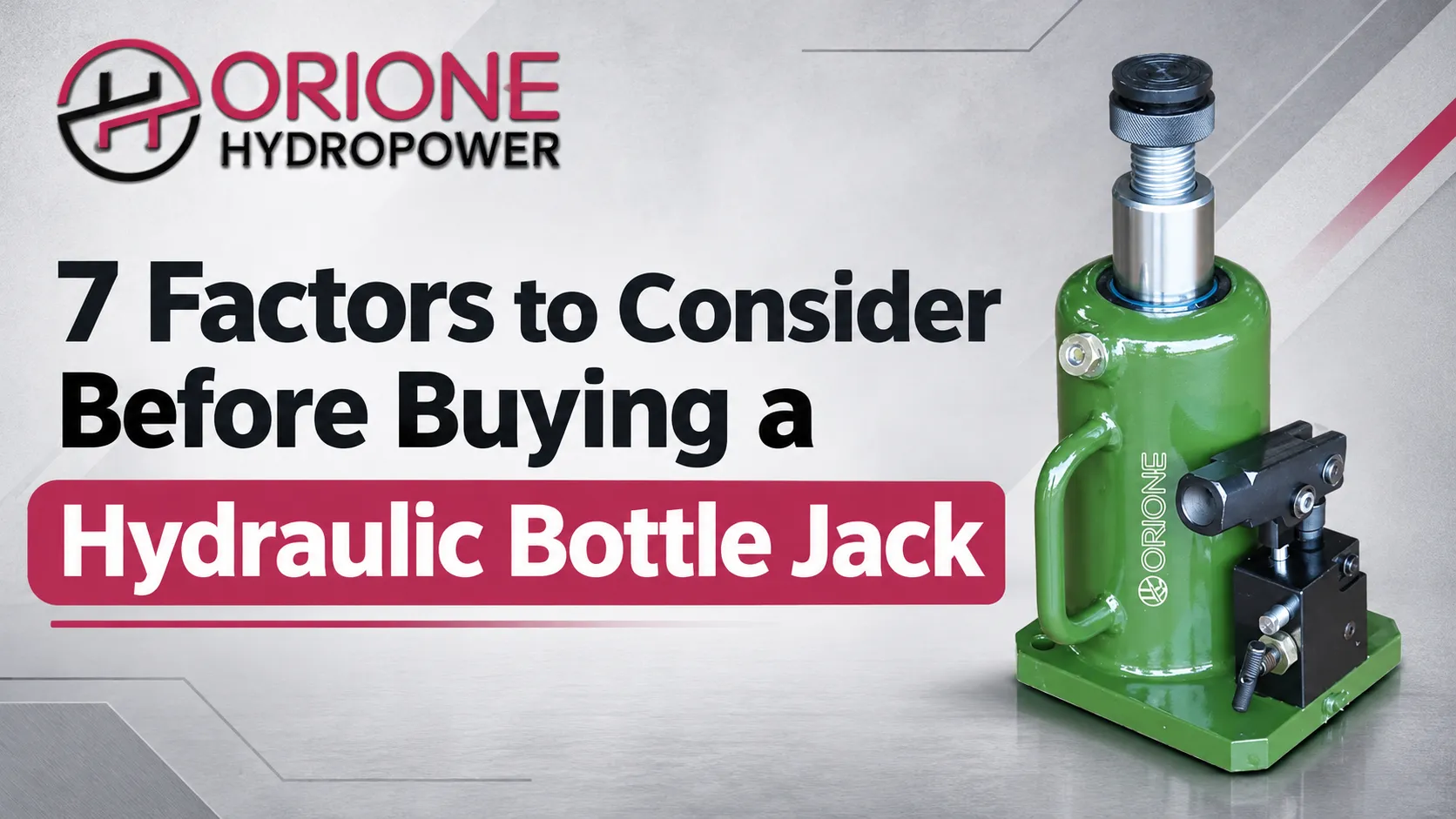
7 Factors to Consider Before Buying a Hydraulic Bottle Jack
19 Views
Quick Summary
A hydraulic bottle jack is a compact lifting tool that can raise very heavy loads with a few strokes of a handle. But jacks are not all the same, and a wrong choice can mean a stuck job, a damaged tool or an unsafe lift. The seven key factors are lifting capacity, height and stroke, build quality, safety features, type and design, working conditions and supplier support. This guide explains each one in simple words.
Table of Contents
-
What Is a Hydraulic Bottle Jack?
-
Why the Right Choice Matters
-
Factor 1: Lifting Capacity
-
Factor 2: Lifting Height and Stroke
-
Factor 3: Build Quality and Materials
-
Factor 4: Safety Features
-
Factor 5: Type and Design
-
Factor 6: Where and How You Will Use It
-
Factor 7: Supplier Support and Value for Money
-
Common Buying Mistakes
-
Conclusion
-
Frequently Asked Questions
What Is a Hydraulic Bottle Jack?
A hydraulic bottle jack gets its name from its shape. It has a round, upright body that looks a little like a bottle, with a ram that rises out of the top. Inside, hydraulic oil moves from a small pump piston to a larger lifting piston when you work the handle. Because the pressure acts on a larger area, a small effort on the handle becomes a very large lifting force. This is Pascal's law at work.
The design is compact and sturdy, so a bottle jack fits easily on a shelf or in a vehicle. It is used in garages, workshops, construction sites, farms and factories, for lifting vehicles, machines, beams and heavy equipment.

Here are the Factors to Consider Before Buying
A jack is a safety tool as well as a lifting tool. A bad choice can damage the load, and in the worst case, hurt someone. A few minutes of thought before buying saves money, time and risk. Here are the seven things to check.
Factor 1: Lifting Capacity
Capacity is the maximum load the jack is designed to lift, and it is given in tonnes. Common sizes for hydraulic bottle jacks range from about 2 tonnes up to 30 tonnes, and larger industrial versions go much higher.
How to choose:
-
Know the real load. Check the weight of what you want to lift. For vehicles, remember that a jack under one end lifts only part of the total weight.
-
Go above the load, not just equal to it. A jack that works at its limit every time wears out fast. Keep a safety margin.
-
Think about future needs. If you might lift heavier equipment later, a slightly higher capacity makes sense.
-
Do not use a jack beyond its rating, even for a short lift.
A bigger jack is not always better. A very large jack may be too tall, too heavy and too slow for a light job. Match the jack to the work.
Factor 2: Lifting Height and Stroke
This factor causes more disappointment than any other. Two numbers matter.
-
Minimum (closed) height: how tall the jack is when the ram is fully down. If this is more than the gap under your load, the jack will not fit.
-
Maximum (extended) height: how high the jack can lift. It must reach the lifting point you need.
Also look at the stroke, which is the distance the ram can travel. Some jacks have an adjustable screw on top, which adds extra reach, but this is less strong than the ram itself, so use it with care.
Factor 3: Build Quality and Materials
A hydraulic bottle jack works under high pressure and heavy loads, so build quality matters.
-
Strong steel body: thick walls and neat welds resist cracking and bulging.
-
Ram finish: a ground and plated ram resists wear and rust, and keeps the seals in good condition.
-
Seals: good quality seals prevent leaks and slow sinking.
-
Base: a wide, solid base keeps the jack stable.
-
Handle: strong, with a good grip, and a design that needs little effort.
-
Paint and finish: helps to prevent rust in damp or dusty places.
-
Oil capacity and filling point: easy to check and top up.
Poor quality shows quickly. Look for rough castings, uneven paint, leaking joints or a loose, wobbly ram.
Factor 4: Safety Features
Safety should never be an afterthought with lifting equipment. Look for:
-
Overload protection: a relief valve that opens if the pressure goes too high.
-
Piston stop or ram limit: prevents the ram from extending too far and coming out.
-
Controlled lowering: a release valve that lets the load down slowly.
-
Stable base and saddle: the load stays centred and does not slip.
-
Test information: a reputable maker can tell you how the jack was tested.
-
Clear markings: capacity and operating instructions on the body.
Remember that a jack lifts, but it does not hold a load safely for long. Always support a raised load with stands, blocks or cribbing before anyone works near it.
Factor 5: Type and Design
Hydraulic Bottle jacks come in a few designs, and the differences matter.
-
Single-stage (plain ram): one ram, simple and strong. Good for most jobs.
-
Telescopic (multi-stage): more than one ram section, which gives more lifting height from a short jack, but with a lower capacity in the extended stage.
-
Low-height bottle jacks: made for tight spaces.
-
Single acting with spring return: the jack lifts with oil pressure, and the spring helps to bring the ram back down.
-
Standard vs heavy-duty industrial versions: designed for tougher, more frequent use.
Also compare bottle jacks with floor (trolley) jacks. A bottle jack is smaller, lighter and often cheaper per tonne, and it works well for vertical lifts. A floor jack rolls into position more easily, and spreads the load over a larger area. The right choice depends on the job.
Factor 6: Where and How You Will Use It
The working environment affects how long the jack lasts.
-
Automotive repairs: Tyre changes, brake work and underbody checks
-
Construction and industrial work: Lifting equipment, aligning structures and supporting loads
-
Emergency rescue operations: Lifting debris or vehicles where fast, compact tools matter
-
Farm and agricultural machinery: Maintenance of tractors, trailers and other equipment
-
House levelling: Raising and adjusting floors or structures
-
General material handling: Moving and positioning heavy objects in workshops and warehouses
-
Frequency of use: a jack used all day needs a stronger build than one used occasionally.
-
Ground surface: soft or uneven ground needs a solid base plate under the jack.
-
Weather and dust: protective plating and good sealing help.
Think honestly about where the jack will spend most of its time, and buy for those conditions.
Factor 7: Supplier Support and Value for Money
A jack is a long-term tool, so the supplier matters as much as the price.
-
Spare parts: seals, handles and oil should be easy to get.
-
Warranty and service: clear terms, and a supplier who responds.
-
Test certificate and documentation: shows the jack has been checked.
-
Customisation: useful if you need a special height or a higher capacity.
-
Capacity range: a supplier who offers several capacities can recommend the right one, and not just sell the one they have.
-
Price: compare the whole offer. The cheapest jack may cost more in repairs and replacements.
If you buy in bulk for a workshop, a fleet or a plant, consider a hydraulic bottle jack manufacturer and supplier who can supply matching jacks and spare parts over time.
Common Buying Mistakes
-
Choosing on price alone.
-
Ignoring the closed height.
-
Buying a jack that is just equal to the load.
-
Forgetting about the ground surface and the base.
-
Using a jack as a support, instead of a lifting tool.
-
Not checking spare parts availability.
-
Mixing up single-acting and double-acting tools.
-
Skipping the instructions, especially on the correct position of use.
Conclusion
Buying a hydraulic bottle jack is easy once you know what to check. Match the capacity to your load, check the closed height and stroke, look at the build and safety features, choose the right design and consider where you will use it. Finally, pick a supplier who will be there when you need spares or advice. A careful choice gives you a jack that works safely for years.
If you are comparing options, you can look at the hydraulic jack range from Orione Hydropower, which includes capacities of 5, 10, 20 and 30 tonnes, with ground and plated plungers and an adjustable lifting height.
Frequently Asked Questions
Q. What is a hydraulic bottle jack?
It is a compact lifting tool with a bottle-shaped body. Hydraulic oil, pushed by a pump piston, raises a ram that lifts heavy loads with little effort.
Q. How does a hydraulic bottle jack work?
It works on Pascal's law. Pumping the handle pushes oil into a larger cylinder, where the pressure acts on a bigger area and creates a much larger lifting force.
Q. What capacity bottle jack should I buy?
Choose a jack rated above the load it must lift, with a safety margin. For vehicles, check the weight each jack will carry, and not only the total weight.
Q. What is the difference between a bottle jack and a floor jack?
A bottle jack is compact and strong for vertical lifting. A floor jack has wheels and a longer reach, so it is easier to position, and it spreads the load over a larger area.
Q. How high can a hydraulic bottle jack lift?
It depends on the model. Look at the closed height, the stroke and the maximum height in the specifications. An adjustable screw can add a little extra reach.
Q. Why is my bottle jack not lifting or sinking slowly?
The usual causes are low oil, air in the system, worn seals or a release valve that is not fully closed. Check the oil, remove air and inspect the seals.
Q. What oil should I use in a hydraulic bottle jack?
Use the hydraulic jack oil recommended by the manufacturer. Do not use brake fluid or engine oil unless the maker approves it.
Q. Is it safe to work under a bottle jack?
No. A jack is for lifting only. Always support the raised load with jack stands, blocks or cribbing before working underneath.
Related Reading
Top 10 Hidden Secrets About Business & Finance You Need to Know
Welcome to our in-depth exploration of Business & Finance. In an era defined...
Why Business & Finance is Transforming the Global Industry Landscape
Welcome to our in-depth exploration of Business & Finance. In an era defined...