10 Benefits of Revenue Cycle Management Services for Healthcare Providers
By vbsglobal
18 Views
Healthcare revenue does not stop when a patient leaves the office. After the visit, there are still claims to submit, payer responses to monitor, denied claims to review, outstanding balances to follow up on, and payments to track. As patient volume and billing activity increase, keeping every part of this process organized can become difficult for an internal team.
Revenue Cycle Management Services help healthcare providers manage these financial activities with greater consistency. From medical billing and claims management to denial follow-up, A/R management, collections, and reporting, RCM support can address areas that often place pressure on healthcare staff. The benefits depend on how the service is structured and which parts of the revenue cycle need additional support.
What Are Revenue Cycle Management Services?
Revenue Cycle Management Services cover the financial and administrative activities involved in getting healthcare providers paid for the services they deliver. The revenue cycle can include billing, claim submission, claim monitoring, denial management, accounts receivable follow-up, patient payments, and collections.
These activities are connected. A problem with claim information can delay processing, an unresolved denial can increase A/R, and inconsistent follow-up can leave outstanding balances open for longer. The American Medical Association describes claims monitoring, denial management, and A/R as important parts of effective revenue-cycle management.
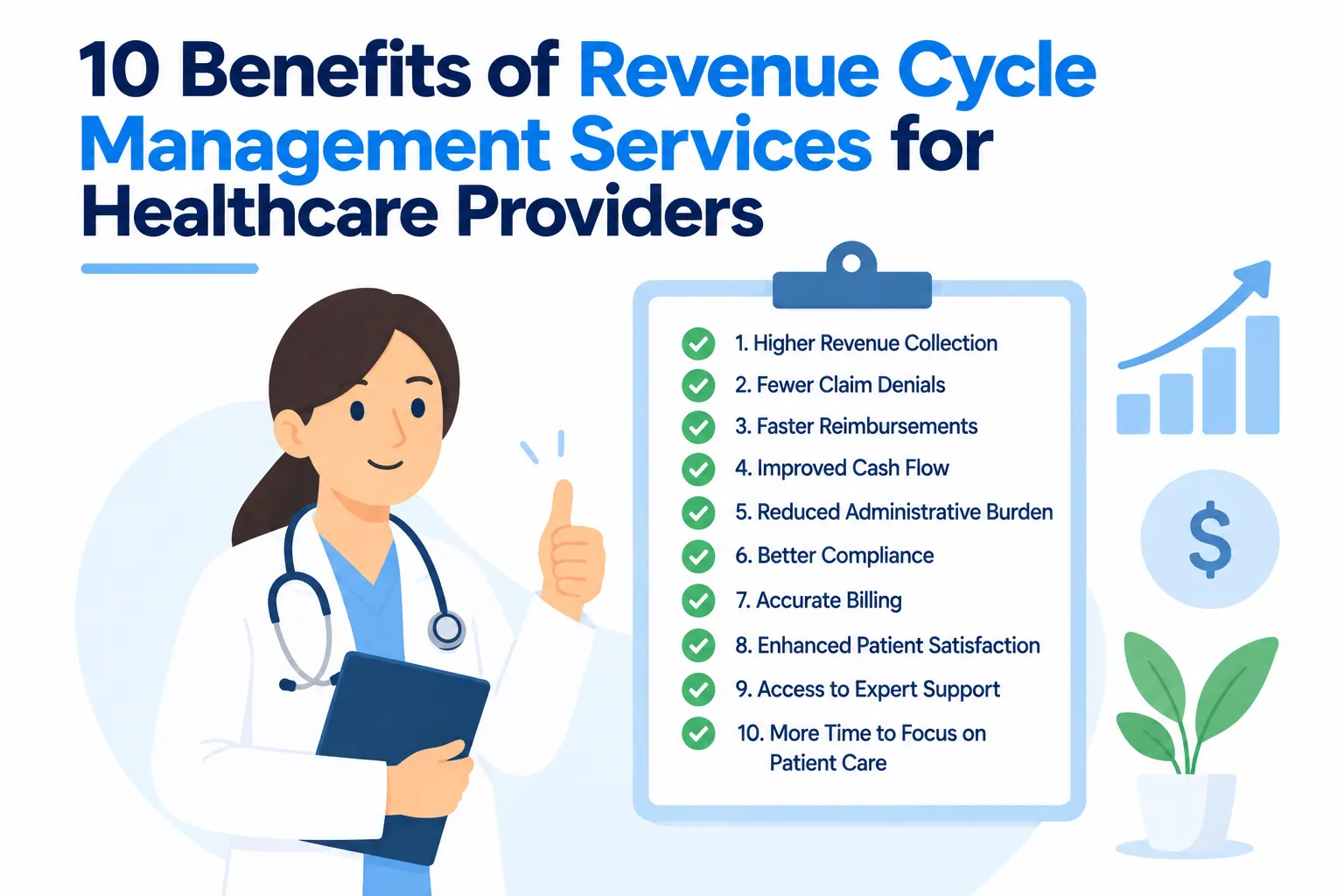
10 Benefits of Revenue Cycle Management Services
1. Reduce Administrative Workload
Billing and follow-up can take considerable time, especially when staff are handling a high volume of claims. Outsourced RCM support can take responsibility for selected repetitive activities, allowing internal employees to focus on other practice responsibilities.
The goal is not simply to move work from one team to another. It is to create a clearer division of responsibilities so important RCM tasks continue to receive attention even during busy periods.
2. Improve Claims Management
Claims need attention after submission. Teams may need to check whether claims were received, monitor payer responses, and identify claims that have been rejected, denied, or left unresolved.
CMS recognizes electronic 276/277 transactions as a standardized method for requesting and receiving healthcare claim-status information. Consistent claim monitoring can give providers better visibility into where claims stand and which accounts need follow-up.
3. Strengthen Denial Management
A denied claim can create additional work for billing staff and delay reimbursement. Effective denial management involves reviewing the reason for the denial, determining the appropriate next step, and tracking the outcome.
It is also useful to look for patterns. If similar claims are repeatedly denied for related reasons, the issue may point to a process that needs attention rather than a series of unrelated mistakes. AMA guidance recommends monitoring denial trends and establishing clear processes for addressing denied claims.
4. Improve A/R Follow-Up
Accounts receivable requires ongoing attention. Simply generating an A/R report does not resolve outstanding balances.
RCM support can help monitor unpaid accounts, prioritize aging balances, check claim status, and maintain regular follow-up. This gives providers a more organized way to manage outstanding receivables and identify accounts that have remained unresolved.
5. Support Faster Payment Follow-Up
Payment delays can occur for different reasons. A claim may still be under review, a payer may need additional information, or an outstanding patient balance may require follow-up.
Consistent payment monitoring helps prevent unresolved accounts from being overlooked. The AMA also emphasizes the importance of having an effective process for collecting payments after a patient has received care.
6. Improve Revenue-Cycle Visibility
Healthcare organizations need more than a total collection figure to understand how their revenue cycle is performing. They also need visibility into claims, denials, A/R aging, payment activity, and other relevant measures.
Regular RCM reporting can make these areas easier to review. Instead of discovering problems only after balances have accumulated, management can use performance information to identify trends and areas requiring attention.
7. Access Specialized RCM Expertise
Not every healthcare organization has the same level of internal RCM expertise. A smaller practice, for example, may depend on a limited number of employees for billing, claims, and insurance follow-up.
External RCM support can provide additional knowledge and operational capacity without requiring the provider to build a larger internal team immediately. The specific value depends on the partner's experience and the functions being outsourced.
8. Improve Operational Consistency
RCM performance can be affected when processes depend heavily on individual employees or when workloads change unexpectedly.
An organized RCM workflow can establish clearer responsibilities for claims, denials, A/R, and reporting. Consistency also makes it easier to identify where a process is breaking down and what needs to change.
9. Scale Support as the Practice Grows
Growth often means more patients, more claims, and more financial activity. A process that worked well at a smaller volume may become harder to maintain as workload increases.
RCM support can provide additional capacity when billing activity grows. Depending on the arrangement, providers can outsource specific functions rather than immediately expanding every part of their internal billing operation.
10. Support Better Financial Decision-Making
RCM data can help management understand what is happening across the revenue cycle. Trends in denial rates, A/R aging, claim processing, and collections can highlight areas that deserve further review.
This information can support operational decisions about staffing, workflows, technology, and where additional resources may be needed. RCM reporting is therefore useful not only for tracking past activity but also for understanding where processes may need improvement.
How Revenue Cycle Management Services Improve the Healthcare Revenue Cycle
Each stage affects the next. An issue during billing or claim submission can create a downstream problem. An unresolved denial can add to A/R, while inconsistent A/R follow-up can leave balances open longer.
For that reason, RCM should be viewed as an ongoing process rather than a collection of isolated billing tasks. CMS supports standardized electronic claim-status transactions, while AMA guidance emphasizes claim monitoring, denial management, A/R review, and performance measurement as parts of effective RCM.
The objective is better process control and visibility, not a guarantee of a particular revenue result.
Who Can Benefit From RCM Services?
Growing Healthcare Practices
Practices experiencing higher patient volume may find that billing and claims activity grows faster than their existing administrative capacity.
Practices With High A/R
A large or aging A/R balance can require regular monitoring and follow-up. Additional support may help practices maintain more consistent attention to outstanding accounts.
Providers Facing Frequent Denials
Repeated denials can increase administrative work and delay reimbursement. Dedicated denial management can help providers review patterns and address appropriate follow-up.
Organizations With Limited Billing Staff
When a small internal team handles multiple billing responsibilities, additional RCM support can provide capacity without requiring every task to remain in-house.
Key RCM Metrics Healthcare Providers Should Monitor
Several measures can help providers understand how their revenue cycle is performing:
- Clean Claim Rate: Indicates how often claims are submitted without issues that require correction or additional processing.
- Denial Rate: Shows the proportion of claims that are denied and can help identify recurring problems.
- Days in A/R: Indicates how long outstanding receivables remain unpaid.
- Net Collection Rate: Helps assess how effectively expected collectible revenue is being collected.
- First-Pass Resolution Rate: Shows how often claims or billing issues are resolved without repeated processing.
- A/R Aging: Groups outstanding balances by age so older accounts can be identified and reviewed.
AMA RCM guidance specifically includes measures such as clean-claim submission rate, denial-related indicators, and A/R aging among useful performance measures.
These metrics work best when reviewed together rather than treating one number as a complete picture of financial performance.
In-House vs. Outsourced Revenue Cycle Management
Managing RCM In-House
Managing RCM internally can give a provider direct control over its team, workflows, systems, and daily communication. It may work well when the organization has sufficient staffing, expertise, technology, and workload capacity.
Outsourcing RCM
Outsourcing can provide additional capacity and specialized support for selected revenue-cycle functions. Providers can choose to outsource specific areas, such as claims, denials, or A/R, instead of transferring every RCM responsibility to an outside company.
The appropriate model depends on the organization's operational needs, internal resources, technology, and level of RCM expertise.
What to Look for in an RCM Partner
Healthcare RCM Experience
Look for experience with healthcare billing and revenue-cycle workflows rather than relying only on general administrative experience.
Claims and Denial Expertise
Ask how claims are monitored, how denials are reviewed, and how recurring issues are identified.
A/R Follow-Up Process
Understand how outstanding balances are prioritized and how aging accounts are tracked.
Reporting and Communication
A provider should have access to useful reports and know how often performance information will be shared.
Data Security
Ask how healthcare and financial information is accessed, stored, transmitted, and protected within the service workflow.
Scalable Support
The RCM arrangement should be able to accommodate changes in workload, patient volume, and operational requirements as the organization evolves.
How VBS Global Supports Healthcare Providers
VBS Global provides Revenue Cycle Management Services for healthcare providers across the USA. Our RCM support covers key areas of the revenue cycle, including medical billing support, claims management, denial management, A/R follow-up, payment collections support, and RCM performance monitoring.
Our team can support workflows involving Medicare, Medicaid, and commercial payers based on the provider's requirements. Dedicated support helps healthcare organizations maintain communication and visibility across their revenue-cycle activities.
For providers looking for additional support with claims, denials, A/R, billing, and collections, explore VBS Global's Outsourced Bookkeeping and Accounting Services.
Final Thoughts
Revenue Cycle Management Services can support healthcare providers across several parts of the financial workflow, from billing and claims to denials, A/R, collections, and reporting. The value comes from maintaining consistent processes and giving teams better visibility into what is happening with outstanding claims and payments.
Before choosing an RCM model, providers should consider their current workload, denial trends, A/R aging, staffing capacity, reporting capabilities, and internal expertise. Whether RCM is managed internally, outsourced selectively, or supported through a broader external arrangement, measurable processes and regular performance reviews can help organizations understand where improvements are needed.
For healthcare providers that need additional RCM capacity, VBS Global offers dedicated support across key revenue-cycle functions and can help organizations structure support around their operational requirements.
Related Reading
Top 10 Hidden Secrets About Business & Finance You Need to Know
Welcome to our in-depth exploration of Business & Finance. In an era defined...
Why Business & Finance is Transforming the Global Industry Landscape
Welcome to our in-depth exploration of Business & Finance. In an era defined...