Dining Out With Hearing Loss: Why Restaurants Are So Hard and How to Cope
By Soft Hear
20 Views
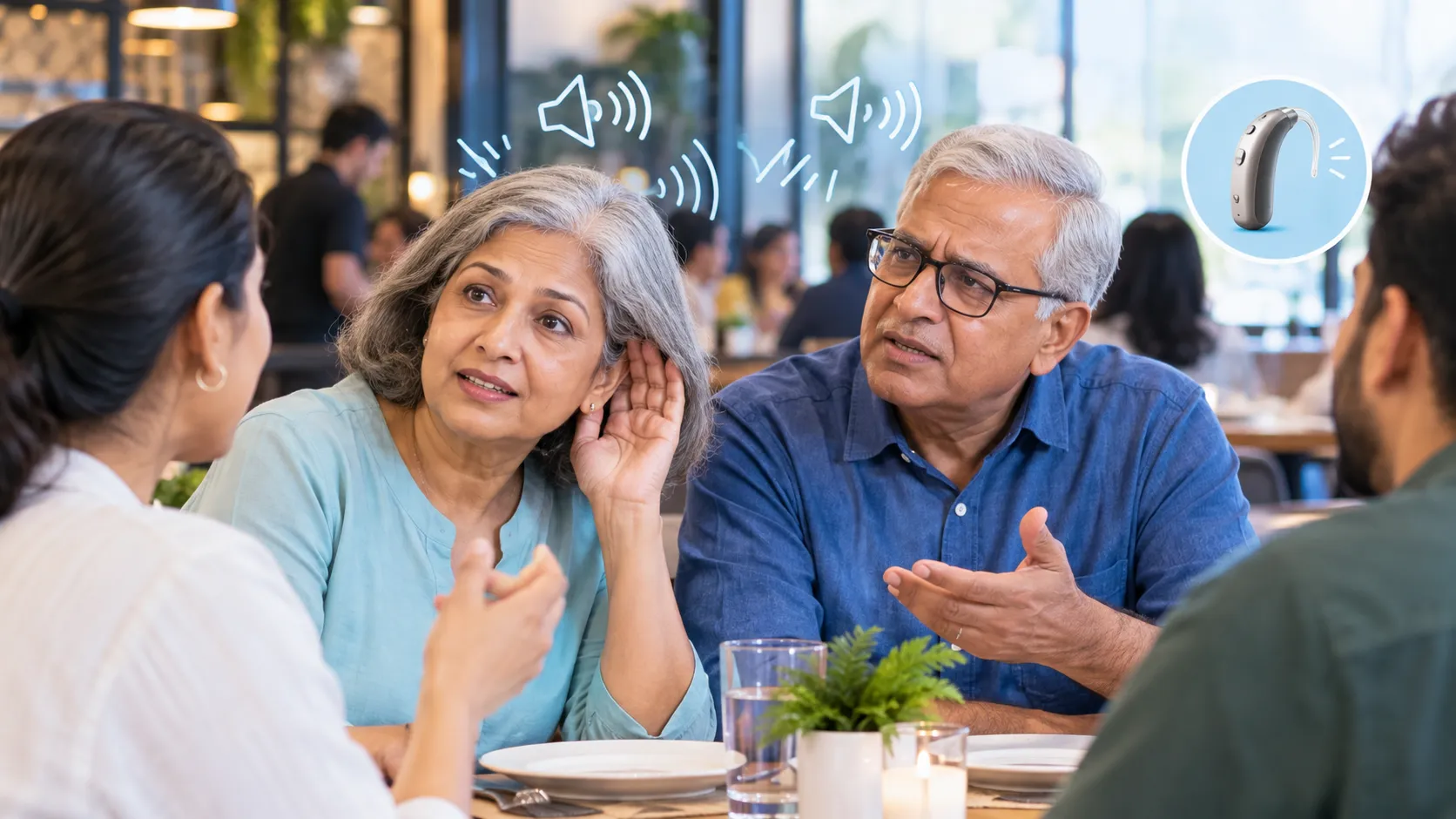
You arrive at a lovely restaurant, ready to enjoy dinner with friends. Ten minutes later you’re nodding along to a conversation you can barely follow, wondering whether anyone will notice you haven’t spoken for a while.
Restaurants, weddings, parties and family functions are widely regarded as the hardest listening environments for people with hearing loss. If you avoid them or dread them, you’re far from alone.
Why restaurants are acoustic nightmares
A restaurant combines nearly every challenge at once:
- Competing conversations from neighbouring tables, all at similar volume to your own companions.
- Background music that blends with speech.
- Clatter from plates, cutlery and kitchen activity.
- Hard surfaces such as floors, walls and glass that bounce sound around.
- Distance and seating that place speakers across the table or at an angle.
- Poor lighting that makes lip-reading and facial cues harder.
For a normal-hearing brain, these are manageable. For a brain receiving a degraded signal, the speech you want gets lost in the soup.
The “cocktail party” problem
Researchers call this the cocktail party effect: the ability to focus on one voice among many. It relies on precise hearing at multiple frequencies and on fast processing. Hearing loss blurs the inputs, so separating voices becomes much harder. That’s why people with mild or moderate loss may cope fine at home but struggle in groups.
Practical strategies for the table
Choose the venue wisely. Suggest quieter restaurants, early-evening bookings or places with soft furnishings. Check online reviews for comments on noise.
Pick your seat. Sit with your back to a wall or corner, so noise comes from fewer directions. Sit beside or opposite your main conversation partner, away from speakers and kitchens.
Mind the lighting. Make sure you can see the faces of the people you’re talking with.
Ask for a quieter table. Many restaurants are happy to accommodate if you ask politely.
Bring a small group. Four or fewer is easier than a table of twelve.
Be open. Tell your friends: “I hear better when we take turns and face each other.” Most people are glad to help.
What technology can do
If you’re considering hearing aids with restaurants in mind, these features are worth discussing:
- Directional microphones that focus on the speaker in front of you.
- Adaptive noise management that reduces constant background sounds.
- Speech-focused processing, including modern AI and deep neural network (DNN) approaches that analyse complex sound scenes and adapt.
- Programs for specific environments that you or the audiologist can adjust.
No hearing aid restores normal hearing, and the very noisiest environments remain challenging. But well-chosen, well-fitted technology can transform an exhausting evening into a manageable, even enjoyable, one. If social gatherings are important to you, this article on choosing a hearing aid for your lifestyle explains how to prioritise features for just those moments.
Don’t buy on features alone
It’s tempting to assume the top-tier model will solve restaurant listening. But performance depends on your specific hearing loss, your speech-in-noise ability and the quality of the fitting. A good audiologist will ask what you struggle with, test your abilities, and recommend technology on that basis, not simply the most expensive option.
Weddings, parties and big gatherings
The same principles apply, with a few additions:
- Arrive early while it’s quieter, to catch up with people before the music starts.
- Step outside or into a quieter corner for important conversations.
- Avoid standing near speakers.
- Take breaks. Listening fatigue is real. Step away for a few minutes to rest.
- Plan a signal with a family member so they can help if you’re lost.
Look after your energy
After an evening of effortful listening, you may feel tired, irritable or flat. That isn’t a character flaw. It’s the cost of working overtime to decode speech. Build in recovery: a quiet morning afterwards, a walk, or simply some peaceful time.
Signs it’s time to get help
- You avoid social events because you can’t follow conversations.
- You pretend to understand, then feel isolated.
- Friends and family comment on the volume of your TV or your repeated “what?”
- You feel anxious about eating out.
Social withdrawal is one of the most important reasons to address hearing loss early. Keeping in touch is good for your emotional health.
The takeaway
Restaurants will never be easy for anyone with hearing difficulty, but they don’t have to be off-limits. With smart seating, honest communication, and technology matched to your needs and professionally fitted, you can rejoin the table and enjoy it.